Soyoil Eyes 66, Diesel Stocks Approach 100 Million, RINs Data Disappoint

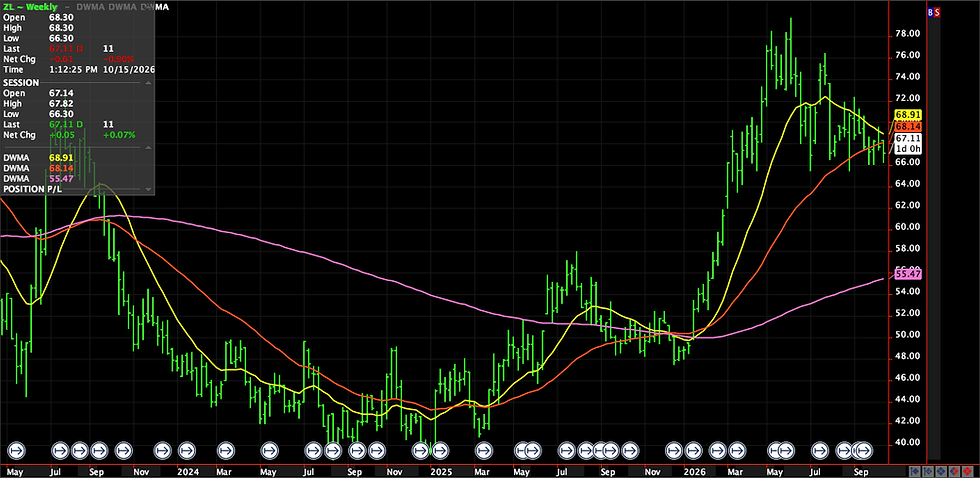
I expect December soybean oil to test 66 cents/lb following the break below its 50-day moving average. The latest snapshot puts December at 67.15 cents against May at 67.71, leaving 0.56 cents/lb of carry, equivalent to $12.35/mt. Carry narrowed during this snapshot, but nearby oil still commands less value than deferred delivery. November Paranaguá export indications sit 1100–1180 below Chicago, discounts of approximately $24 to $26/mt. Brazil projects a 181.6 million mt soybean crop, up 0.7%, while the Argentine headline forecast stands at 50 million mt. These remain forecasts, but physical discounts and the technical break reinforce my preference to sell soybean oil rallies. A test of 66 cents would remove another $25.35/mt from December oil value and there isn't much support below.
In NWE, the spot barge window showed different conditions across biodiesel grades and renewable diesel. FAME 0 averaged $1,596.17/mt, down $87.58 from yesterday, while RME fell $31 to $1,794/mt. UCOME gained $5.50 to $1,729.50/mt, taking its premium over FAME 0 to $133.33/mt. RME commanded $197.83/mt over FAME 0, while HVO Class II held at $2,700.27/mt, up $1.94. Nearby rapeseed oil offers fell €15 to €1,245/mt, but finished biodiesel weakness limits the margin benefit. November-January gasoil backwardation remained $81.25/mt. Cumulative rapeseed imports reached 871,500 mt through September 27, 14% below last year, with Ukrainian arrivals down 44% to 336,000 mt. Australia supplied 185,100 mt, up 35%, although freight will determine its competitiveness for subsequent shipments.

US distillate inventories leave dangerously little protection against further disruption. Stocks fell 2.5 million barrels to 102.6 million, 12.3% below last year, despite refinery utilisation of 93.5%. Another two weeks at this draw rate would leave 97.6 million barrels. Four-week distillate supplied averaged 3.974 million bpd, down only 0.2% year on year. September D4 generation increased to 788.1 million RINs from a revised 716.0 million in August, up 10.1%, or 13.7% on a daily basis. D5 generation fell 19.2% to 27.8 million, leaving combined D4 and D5 generation up 8.7% at 815.9 million. Nine-month D4 generation reached 6.162 billion RINs, comprising 4.067 billion from renewable diesel, 1.698 billion from biodiesel and 397.0 million from renewable jet fuel. This covers only 67.9% of the existing 9.07 billion annual biomass-based diesel requirement after 75% of the year. Matching this volume through current-year gross generation alone requires 969.5 million RINs per month in the fourth quarter, 23.0% above September. Carryover credits, retirements and other adjustments determine the actual compliance balance, but the production pace still lags the RVO.

US SAF moved in the opposite direction to total D4 generation. September domestic renewable jet generation fell 30.0% to 34.6 million D4 RINs, representing 21.6 million gallons, while jet inventories stood 3.6% below last year. Domestic SAF generated 347.4 million RINs through September, distinct from the 397.0 million total including foreign supply. The federal SAF blending credit expired after December 2024, while Section 45Z rewards eligible domestic producers. Downstream buyers therefore depend on delivered prices and other incentives to make blending attractive. This leaves a weakness in translating producer support into consumption, although September’s decline alone does not establish its cause. EPA’s proposed additional 770 million SRE reallocation remains unresolved between 2026 and 2027 and covers several fuel categories, rather than D4 alone. Rising overall D4 generation also challenges any assumption of weakening biofuel activity across the industry. This RVO lag in renewable/Bio production seems in contradiction to the fact that we are running dangerously low on Distillate stocks.

In Asia, stronger palm exports have failed to prevent lower prices. Malaysian October 1–15 shipments reached 785,564 mt, up 58.3%, yet December dollar palm fell $18.50 to $1,192.25/mt. November POGO finished at minus $220.50/mt, December at minus $157.65 and January at minus $101.09. Against my working minus $250/mt threshold for discretionary PME blending, November still needs another $29.50/mt of relative palm weakness, December $92.35 and January $148.91. September freight indications for 20,000 mt Straits–Rotterdam vegetable oil and biofuel parcels stood at $150/mt, up $65 year on year, limiting the reach of cheaper Asian supply. My position remains bearish soybean oil and bullish diesel. Faster production to meet the D4 requirement challenges the oil outlook, but export discounts and carry support a test of 66 cents. I view the Russian arrangement as an effort to restore global diesel supply, with indirect benefits for the US if overseas buyers require fewer American barrels. Sustained deliveries and an inventory recovery are needed before I change my diesel view.


Comments