Diesel at $200/Barrel Globally, $7 at the Pump in US Next?

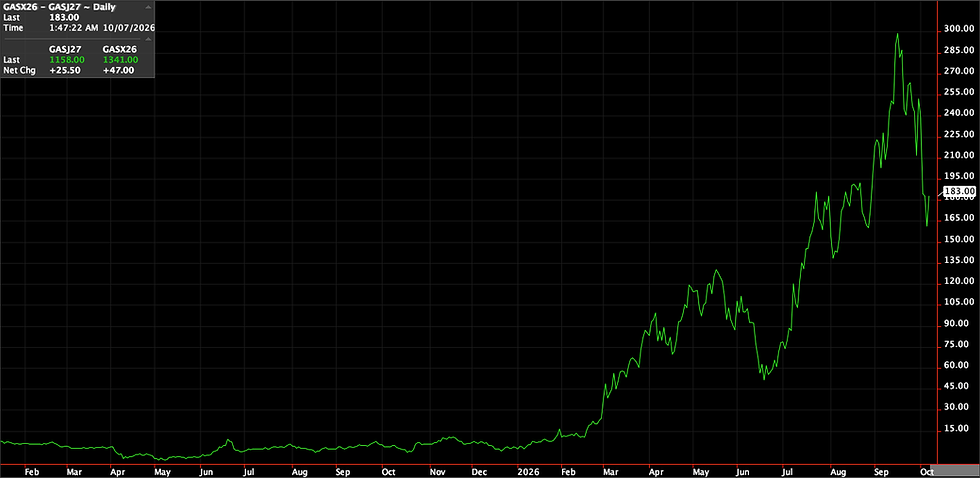
The latest US heating-oil quote of $4.9433/gallon puts diesel at $207.62/bbl, with the heating-oil/WTI crack at $113.42/bbl. European gasoil is close to the same outright level: October expired with $1,483/tonne on the screen, roughly $199/bbl using 7.45 barrels per tonne, while November subsequently reached $1,465.75/tonne, approximately $197/bbl. October/November backwardation narrowed to around $20/tonne, but November/January widened from $69.50 to $83/tonne, up 19.4%. US November/January heating-oil backwardation also widened to 26.45 cents/gallon, up 24.4%. October’s expiry has not removed the premium for earlier winter delivery. The latest weekly assessments nevertheless show regional differences, with NWE diesel cracks at $91.15/bbl against Singapore at $67.14/bbl.

NWE biodiesel trading provides evidence of an active market. The supplied weekly series records 998kt in Week 40 across RME, FAME 0, UCOME and HVO II, up 75.2% from 569,5kt in Week 39. Today’s closing paper tally included 32,5Kt across UCOME contracts and its November/December spread, alongside 62kt in the HVO II November/December spread. November UCOME’s last-traded/current premium ended at +$270/tonne, up $15, while December finished at +$272, down $8. The physical window reported eight UCOME deals at premiums of +$290–300/tonne, averaging +$292.50 and $1,717.50/tonne outright, up $37.56 from yesterday. The eight deals demonstrate nearby buying activity. Replacement diesel also faces competition from jet, whose latest weekly NWE crack was $97.11/bbl and whose ARA stocks of 479,000 tonnes were 55% below last year. Inland delivery remains constrained by Kaub at 19 cm against its 77 cm low-water reference.

Asia’s closing palm figures show a nearby feedstock discount that diminishes further out. November dollar CPO finished at $1,184/tonne and December at $1,205.25, while May stood at $1,260, leaving $76/tonne of November–May carry. December POGO closed at minus $127.94/tonne, whereas March remained at a $27.95 premium. Malaysian September palm stocks were 3.51 million tonnes. Returning Chinese mineral product exports, indicated at around 3.7 million tonnes for October accompanied Singapore diesel cracks easing to $67.14/bbl. Europe’s higher diesel values encourage westbound sales, but the October 9 shipping indication was $18.4 million for a large product-tanker cargo from the Middle East to northwest Europe, absorbing part of that price advantage. Brazilian soybean oil also remains discounted to Chicago: the October 12 nominal holiday indications put Paranaguá December offers at 1.22 cents/lb under futures and bids at 1.35 cents under, equivalent to $26.90–29.76/tonne. April/May discounts were deeper at 1.46–1.65 cents/lb, or $32.19–36.38/tonne, consistent with additional supply expectations around a prospective 186-million-tonne Brazilian soybean crop.
In the US, EPA’s announced proposal would reallocate 100% of the additional 2025 SRE volumes above those already projected; the allocation between 2026 and 2027 remains unresolved. December 2026 D4 traded at $2.065, down 2.64%, while December 2027 stood at $2.168. The displayed December production models nevertheless improved to $1.2089/gallon for renewable diesel and $2.1926 for conventional biodiesel, gains of 25.16 and 24.55 cents under their respective assumptions. The roughly 98-cent gap gives Gulf RD producers reason to examine West Coast LCFS value, although the delivered netback still requires pathway-specific credit and freight calculations. The federal tax incentive now sits with producers rather than downstream blenders. An illustrative extra $1/gallon on a renewable component comprising 5% of diesel sales contributes $2.10/bbl across that pool, modest beside the $113.42/bbl gross fossil diesel crack. That is why Refiners are not in hurry to comply with RFS. EPA’s extension of the 2025 compliance deadline from September 1 to October 1, 2026 also demonstrates timing flexibility without reducing the obligation. I see these factors as possible contributors to limited immediate feedstock urgency: December soybean oil remains 0.25 cents/lb below January and 0.67 cents below May, equivalent to $14.77/tonne of carry through May.

My base case remains higher diesel prices, with a US national pump average approaching $7/gallon a credible risk by November 3. From the current average of $6.2787, that requires another 72.13 cents, or 11.5%, in three weeks. Heating oil above $207/bbl and widening winter spreads support the direction of that forecast, although neither establishes the eventual retail price. In my view, the emphasis on tax relief risks cushioning consumption and delaying the demand destruction needed to balance supply. I expect that political preference to persist through election day, leaving prices to bear more of the adjustment. If supply fails to recover and consumption does not retreat sufficiently, export restrictions or rationing become a greater post-election risk. Those are forecast scenarios, not announced measures. Recovering supply and sustained narrowing of winter backwardation would weaken the call; today’s spreads keep me leaning towards higher diesel first and a greater risk of emergency intervention afterwards.


Comments