Palm Opens a Blending Window as Diesel Cracks Hold Above $100/Brl

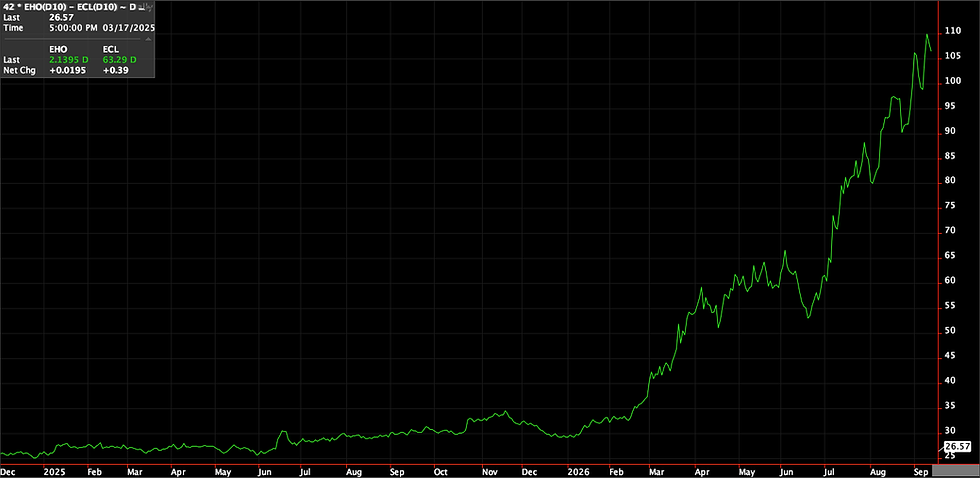
Diesel’s underlying strength remains the defining feature of September 14, despite a pullback in fuel prices during the session. The heating-oil crack chart remains around $105–110/bbl, compared with roughly $30–35/bbl early in 2026. Last week’s European diesel cracks reached $104.51/bbl and Singapore gasoil cracks $89.45/bbl, while ARA jet inventories stood 59% below a year earlier. Against that backdrop, October gasoil’s latest decline of $15.75/t to $1,463.50/t represents some relief from exceptionally high levels. October soybean oil gained 0.46¢/lb to 69.65¢/lb, equivalent to $1,535.50/t, leaving BOGO at plus $72/t. That is $25.89/t wider on the day, but dramatically below the roughly +$650–675/t seen around midyear.
Palm has moved far enough below gasoil to put additional physical demand into consideration. October POGO around minus $190/t leaves indicative PME approximately $90/t below gasoil after allowing a minimum $100/t to convert CPO into biodiesel, before freight and other delivery or blending costs. This could encourage discretionary PME blending into gasoil in Southeast Asia, beyond existing mandated demand in Indonesia, as we have seen before. The window is concentrated in the nearby month: November POGO at minus $92.75/t puts PME roughly $7.25/t above gasoil using the same conversion allowance. Malaysian August palm stocks of 2.824 million tonnes, up from 2.628 million in July, provide a nearby supply cushion. Whether that cushion finds an additional fuel outlet now depends on how much of October’s discount survives in executable PME offers and also how many agressive traders are willing to play this game to stretch the diesel supplies.

European renewable fuels showed a different pattern. October HVO II premiums rose $85/t to $1,670/t and HVO IV gained $95/t to $2,030/t, while October UCOME premiums slipped $2/t to $288/t and the RME/FAME differential narrowed $25/t to $130/t. Feedstock costs also moved unevenly: Dutch September rapeseed oil rose €15/t to €1,255/t, while February–April fell €24/t to €1,203/t, widening the nearby premium from €13/t to €52/t. Last week’s firmer European UCO contrasted with a $110/t weekly decline in Malaysian PFAD offers to $1,000/t. Logistics further complicate the picture on the Rhine river: Kaub recovered 7cm to 34cm but remained 43cm below its equivalent low-water reference, keeping inland deliveries constrained. Stronger HVO premiums therefore should not be read as evidence that every biodiesel grade or waste feedstock is tightening together.
Soybeans face a separate test of bullish expectations. Managed money held a record net long of approximately 266,000 futures-and-options contracts on September 8, ahead of an increase in estimated US soybean yield from 52.7 to 52.8 bu/acre. China’s official 2026/27 soybean import forecast remains 95.5 million tonnes against 108 million for 2025/26, implying a decline of 12.5 million tonnes, or 11.6%. The forecast deserves scrutiny, given that the previous season’s estimate rose from roughly 96 million to 108 million tonnes. Nevertheless, heavy speculative exposure leaves the market sensitive to demand disappointment, and stronger Chinese purchases from the US could partly replace South American shipments rather than expand total imports. Soybean-oil availability remains a distinct question: combined US, Argentine and Brazilian consumption is forecast to grow approximately 2.4 million tonnes in 2026, exceeding production growth of 1.7 million tonnes.

My feeling is that I am recognizing some recessionary trends in feedstocks particularly in Asia, Subcontinent and Mideast and perhaps even Europe. High Diesel values are not helping. Our late-morning October US Bio margin indications fell approximately 8¢/gal for both soybean-based renewable diesel and conventional biodiesel, while modeled renewable diesel margins declined along the curve from $1.84/gal in October to $1.01 in March. European HVO premiums strengthened despite being stranded in ARA, and palm’s nearby discount opened the possibility of blending on outright economics beyond mandated volumes in SEA. As the industry gathers in Monterey for the September 15–17 biofuels summit, October POGO deserves particular attention as feedstock pressures are gathering pace. At roughly minus $190/t, it provides a potential incentive for additional PME consumption; November’s minus $92.75/t shows how quickly that incentive disappears. The next signal is whether the October discount translates into actual discretionary blending demand in SouthEast Asia where PME is widely produced.


Comments