Diesel Prices Weekend Risk, Soyoil Awaits Replenishment

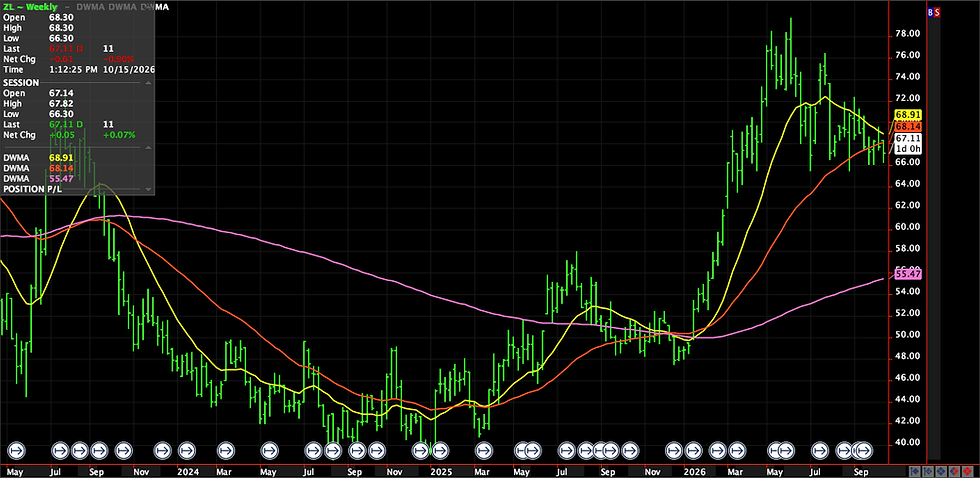
Friday’s energy recovery comes alongside unconfirmed market talk of further military action in the Middle East over the weekend. Timing remains unconfirmed, and price movements alone do not establish the rumours as the cause. November gasoil rose $28.50 to $1,457/mt, while November/December backwardation widened from $41.75 to $45.25/mt, up 8.4%. November/January increased $5.75 to $84/mt. US ULSD reached $4.9116/gal, equivalent to $206.29/bbl, with the heat crack at $104.71/bbl. December BOGO fell $26.10 to $67.54/mt, down 27.9%, showing soybean oil lagging gasoil despite recovering its moving averages. Higher diesel values improve biofuel replacement economics, but weaker US credits absorb part of the revenue gain.

In NWE, today’s indicative November paper values put FAME 0 at $1,503–1,523/mt, RME at $1,658–1,678 and UCOME at $1,678–1,698. Midpoint premiums over the same report’s gasoil swap were $115, $270 and $290/mt respectively. November HVO paper stood at $2,628–2,648/mt. December midpoints were $1,482/mt for FAME 0, $1,607 for RME and $1,647 for UCOME, discounts of $31, $61 and $41 to November. These forward indications leave inland transport as a separate purchasing consideration. Kaub stood at 7 cm in today’s river briefing, 70 cm below its low-water reference. The improved forecast peaked at 58 cm on October 24, still below the 77 cm reference. Buyers scheduling inland deliveries have prospective rainfall relief to assess, while confirmed barge capacity remains essential. This is valid for both Biodiesel and diesel.
In the US, December D4 fell 3.22% to $1.890, bringing its decline from $2.429 on July 17 to 22.2%. Today’s approximately 6.3¢ loss per RIN removes roughly 9.4¢/gal from conventional biodiesel revenue and 10.1¢/gal from renewable diesel at equivalence factors of 1.5 and 1.6. September D4 generation rose 10.1% to 788.1 million RINs, but nine-month generation reached only 67.9% of the annual biomass-based diesel requirement after 75% of the year. This measures production pace rather than a net compliance deficit, since carryover credits also contribute. EPA’s proposed additional reallocation includes 180 million biomass-based diesel RINs across 2026–27, with 90 million assigned to 2026 under the equal split or none under the 2027-only option. EPA expects carryover credits to meet the additional obligations, limiting the basis for treating the proposal as immediate new feedstock demand.

Asia’s latest data show stronger palm exports alongside substantial soybean arrivals. China imported 11.88 million mt of soybeans in September. Malaysian October 1–15 palm exports reached approximately 802,500 mt, up 43.2% from the corresponding September period. Today’s December dollar CPO indication rose $6.75 to $1,199/mt, while second-quarter 2027 fell $4 to $1,233.50. November POGO was minus $208.85/mt, December minus $149.89 and January minus $96.30. Against my working discretionary PME blending requirement of minus $250/mt, those discounts fall short by approximately $41, $100 and $154/mt respectively. Palm needs to weaken relative to gasoil to meet this assumed threshold. China’s August SAF exports of 131,000 mt, up 37% monthly and directed predominantly toward Europe, add a separate renewable supply flow for European buyers to monitor.

Yesterday’s September crusher figures present the strongest challenge to my bearish soybean oil view. Oil stocks fell to 477,600 mt, down 12.3% monthly and 15.3% annually, the lowest since November 2014. Crush declined 4.5% monthly to 5.34 million mt, so reduced production contributed to the tighter balance. Yet US soybean harvest reached 46% on October 11 after advancing 21 percentage points in one week, while December/May oil still trades around minus 0.59¢/lb, or $13/mt. Oilshare near 48.5% measures relative product revenue, while carry remains consistent with expectations of replenishment. I expect recovering crush to rebuild oil stocks. Diesel needs replenishment from a US inventory level of 102.6 million barrels, with weekend escalation adding another potential disruption to refining or shipping. The announced release of more than 20 million barrels of emergency diesel offers relief, equivalent to approximately 667,000 b/d if 20 million arrives over 30 days. Delivery timing and destination will determine its impact. I remain bullish diesel and bearish soybean oil, with inventory rebuilding the next test for both views.



Comments