A Wall of Dollar Liquidity: The Strong RMB's Impact on the Biofuel Arbitrage

Global distillates and bio-complexes are opening the week under divergent pressures, as headline geopolitical relief clashes with an aggressive widening in physical curve structure. Prompt energy softened early on—with November ULSD dipping 4.72¢ to $4.8519/gal (-0.98%) and Dec Brent easing $2.18 (-1.57%) to $107.68/bbl—as desks absorbed Washington’s 60-day review waiver on Russian diesel (slated at 2.3 mm bbl this month and scaling to 7.6 mm bbl/month) alongside G7 stock release discussions. Yet despite all the noise surrounding Russian relief barrels and Ukrainian refinery strikes, prompt tightness is asserting itself forcefully on screens: prompt-to-deferred ICE Gasoil backwardation exploded today, with the Nov/Apr (GASX26–GASJ27) spread widening +11.50% from $191.25/mt to $213.25/mt, while Nov/Dec (GASX26–GASZ26) trades backwardated by $47.00/mt. Physical transits through Hormuz remain constrained at 8.5 mb/d (roughly 70% below pre-war levels), keeping the underlying fossil floor intact. For renewable fuel blenders, this steepening gasoil curve combined with a collapsed BOGO spread creates immense prompt replacement incentives, even as downstream road-fuel compliance markets take a breather.

In Northwest Europe (NWE), the market is wrestling with severe physical distribution bottlenecks alongside softening green premiums. The Rhine River remains paralyzed, with the Kaub gauge pinned at an extreme 15 cm (62 cm below GIW), slashing tank-barge loading capacity to 20% to 25% of normal and driving spot barge freight up to €255.00/t into Basel (+€6.00/t w/w), €230.00/t to Strasbourg (+€4.50/t), and €212.50/t to Karlsruhe (+€7.50/t), against €7.38/t for intra-ARA moves. Compounding this, Italian truckers protesting diesel pump prices of €2.16 to €2.25 per liter have blocked Sicilian ports for four days and shut transport arteries in Naples, further constricting Mediterranean product flows. This logistical gridlock has trapped renewable fuels in ARA terminals. Consequently, HVO premiums have weakened despite Neste’s Rotterdam turnaround and Porvoo restart delays, pulling German THG and Dutch LRE compliance tickets down sharply. In the FAME complex, winter-grade RME holds relative strength against FAME 0, while UCOME continues to lose ground amid absent spot demand. On a flat price basis, European UCO is quoted at $1,300 to $1,305/t CIF ARA in containers, $1,365 to $1,375/t CIF ARA bulk, and €1,280 to €1,290/t DDP NWE. Meanwhile, spot SAF premiums remain anchored near historic lows, as European airline blending quotas for 2026 appear largely fulfilled.

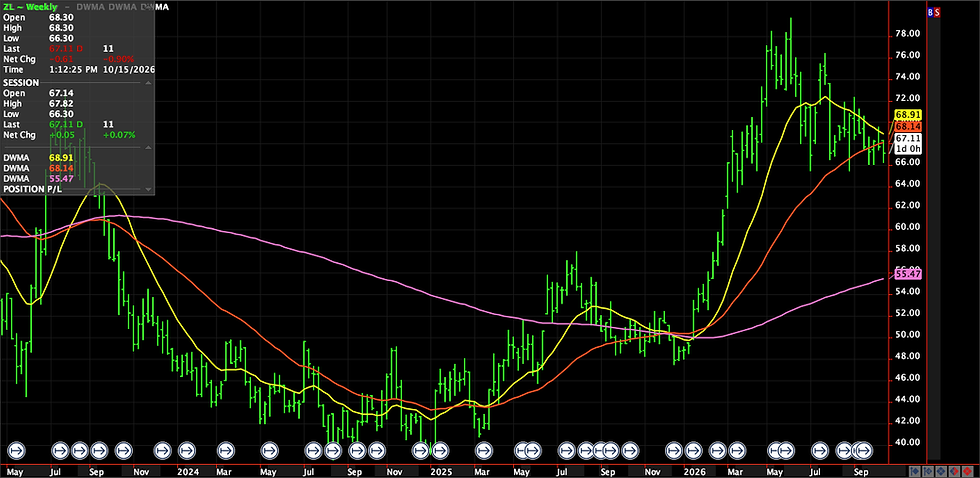
In the United States, retail diesel has proven stubbornly sticky even as futures screen prices have slipped a few cents. According to AAA, the national retail diesel average stands at $6.3187/gal—virtually unchanged from yesterday's $6.3224/gal and actually higher than last week's $6.2665/gal—while Arizona diesel holds firm at $6.3729/gal (up from $6.1998/gal a week ago). On trading desks, the focus remains on regulatory uncertainty and expanding margin incentives to blend against high fossil distillates. CME December soybean oil settled at 67.13¢/lb (down 1.31% on the week) and recently touched 66.70¢/lb, pressured by South American crop expectations and a lag in domestic crush pace, even as NOPA bean oil stocks dropped to a 10-year low of 1.05 bn lb. With December gasoil holding near $1,411.75/mt, the Dec BOGO spread (ZLZ26*22.046 – GASZ26) has collapsed from highs near $700/mt down to just $58.72/mt, while prompt heating oil crack spreads hover above $102/bbl. This dramatic narrowing in BOGO drastically improves discretionary blending margins for bio-feedstocks. Meanwhile, the D4 RIN complex remains subdued around 1.90, as traders weigh the EPA’s pending treatment of the 770 million SRE reallocation against USDA projections of 17.8 bn lb of soyoil for biofuels (an implied 600 to 630 million RIN excess). Domestic waste feedstocks remain steady, with USDA AMS yellow grease prices flat week-over-week across all regions—averaging 46.25¢/lb FOB Minnesota ($1,020/mt), 50.50¢/lb FOB Central Coast ($1,113/mt), and 67.00¢/lb delivered Southern California—while Gulf UCO delivered holds at 71.00¢/lb ($1,565/mt). On the river, the Mississippi faces late-month draft risk as St. Louis stages drop from 9.76 ft toward 1.8 ft by early November, while the Cairo–Memphis corridor alerts at 567.19% of tariff ($17.81/ton), down 12.7% versus its 90-day moving average.

While the Western press remains fixated on Russian relief barrels, the true driver of the global diesel swing is China. Chinese refined product exports jumped 39.4% year-on-year in September, led by a massive 262% surge in diesel exports to three-year highs as state refiners capitalized on global supply shortages. Crucially, this export flood is not a sign of economic health; Sinopec projects domestic diesel consumption to drop 11.4% in 2026, leaving refiners structurally forced to dump surplus barrels onto the international water. At the same time, the steady strengthening of the Renminbi down toward 6.69 is reshaping trade finance. Behind this currency firmness lies a structural wall of dollar liquidity: on top of massive trade surpluses reaching $938.1 billion through Q3 2026, China’s estimated $3 trillion in diversified dollar reserves—parked across official accounts, state-owned commercial banks, and offshore clearing hubs—is generating roughly $12.5 to $13.75 billion per month in interest at prevailing 5.0% to 5.5% yields. For global biodiesel and renewable diesel traders, this currency dynamic is a critical double-edged sword: as the RMB strengthens, it inherently raises the dollar-denominated export cost of Chinese UCO, squeezing the arbitrage margins for Western refiners who rely on imported Asian feedstocks. We already see this in offers: China FOB export UCO stepped up sharply to $1,160 to $1,180/t for RED standard bulk (up $45/t mid) and $1,185 to $1,200/t for premium bulk (up $22.50/t mid), even as East China inland collecting prices held flat at ¥7,550/t and ¥7,850/t. In the broader vegoil space, Bursa Malaysia CPO third-month futures rallied 3.85% on the week to 4,769 ringgit/t ($1,169/mt), with cash CPO trading at $1,240/t CFR West Coast India, bolstered by slower early-October output (-1.79%), strong Indian festival buying, and talks of a temporary waiver on Malaysia's 10% export levy.

Looking ahead, the global trading complex remains trapped between paper-driven relief and unyielding physical constraints. While Russian waiver announcements and G7 discussions provided brief psychological relief, retail pump prices remain historically high, and the violent surge in Nov/Apr gasoil backwardation above $213/mt underscores that the physical prompt distillate deficit is nowhere near resolved. In reality, the global diesel balance will hinge on whether China continues exporting surplus barrels into the Atlantic and Pacific basins to offset Middle East and Russian disruptions. For renewable diesel and SAF, the collapsed BOGO spread offers strong economic support to blend, but the immediate obstacles remain poor downstream liquidity, depressed ticket values, and logistical gridlock along Europe's waterways and ports. Over the next 48 hours, monitor how the Italian transport strikes develop, keep an eye on whether RMB strength further widens Asian UCO replacement costs, and watch Wednesday’s EIA weekly report to see if US distillate draws breach the critical 100-million-barrel threshold.


Comments