Gasoil Backwardation Near +300 Again as Hormuz Disruption Escalation Tightens Global Supply
- Henri Bardon
- 2 days ago
- 3 min read

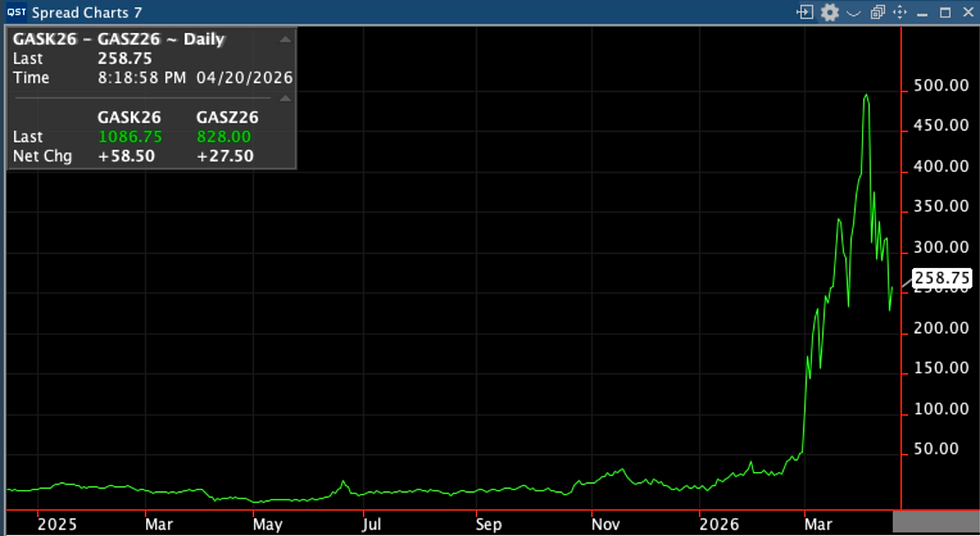
The defining feature today is the continued strengthening of the ICE gasoil structure, with the May/Dec spread now approaching +$300/mt. That level of backwardation reflects immediate scarcity and a strong incentive to pull barrels forward. Even with Singapore gasoil 10ppm easing to $157.81/bbl, down $2.12 on the day, the forward curve is tightening, confirming that prompt supply remains constrained.

The situation in the Strait of Hormuz is now a major driver. Inbound vessel traffic has collapsed compared to late February levels, with only a fraction of normal tanker flows observed in recent days. This follows the US interception of an Iranian VLCC bound for China and the effective blockade of Iranian-linked flows. The result is a sharp disruption in crude and product logistics at the source. Even if flows resume, normalization would take weeks given voyage times and repositioning constraints.

The divergence between Asia and the Atlantic Basin is becoming more pronounced. ULSD NWE CIF is up $44.25 to $1,165.75/mt, while Asia is seeing incremental supply response with refiners offering more May cargoes and margins recovering to about $46.6/bbl. Singapore cash differentials have eased toward $17/bbl, indicating more prompt availability. However, this regional softness is not offsetting the structural tightening caused by disrupted Middle East flows.
The constraint is now clearly at the crude quality and blending level. Refiners are pulling heavy sweet crude into runs to replace missing Middle East barrels, reducing availability of low sulphur blending components and forcing prioritization of diesel and jet output. At the same time, VLSFO premiums remain elevated around $17/mt compared to roughly $2/mt before the disruption, while HSFO cracks are back near minus $0.30/bbl with Russian supply staying high. The system is not short crude, it is short clean barrels and compliant blending material.
Jet fuel confirms the same pattern. Asia softened with Singapore jet down roughly $5 to $9/bbl, yet regrade remains near $19/bbl and Atlantic Basin jet continues to trade firmly with NWE CIF at $1,483/mt and US jet above $3.60/gal. Refiners are maximizing distillate output, but regional dislocations keep the global system tight. Heat Crack margin remains at a very high level of $62/brl on screen.

In NWE biodiesel, spot barge trades in the window continue to print at strong premiums over ICE gasoil, which means flat prices are rising sharply alongside the futures rally. UCOME traded at $459–480/mt over gasoil, RME around $305/mt, and FAME near $270–275/mt. With ICE gasoil around $1,085–1,135/mt, UCOME flat prices are now in the $1,550–1,600/mt range, while HVO Class II at $1,628–1,705/mt over gasoil implies flat prices approaching $2,800–2,900/mt. These are elevated levels driven by physical scarcity.
Feedstocks remain firm. UCO CIF USGC is at $1,243/mt, up $18, soybean oil Chicago swaps at 69.45 c/lb up 1.41, and tallow FOB Latin America at $1,050/mt. This continues to pressure margins, particularly for renewable diesel. The structural disadvantage remains carbon intensity. Renewable diesel carries a higher CI profile than conventional biodiesel on similar feedstocks, which reduces 45Z credit potential. With RD margins already near breakeven or negative before credits, the effective margin is weaker than for conventional biodiesel producers.
The combination of a $300/mt backwardation in ICE gasoil and a sharp drop in Hormuz tanker traffic points to a system under immediate stress. Asia is beginning to respond with higher runs, but the Atlantic Basin continues to price scarcity. As long as flows through Hormuz remain disrupted, distillate tightness will persist and biofuels will remain critical to balancing the system.


Comments