Europe Pulls Barrels as Diesel Tightness Deepens While US Biofuels Lag
- Henri Bardon
- Apr 20
- 4 min read

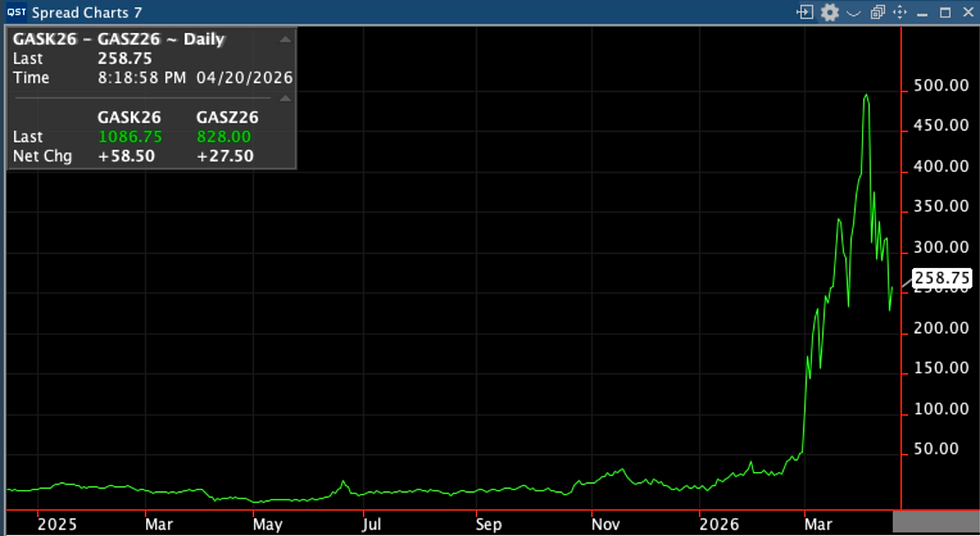
ICE gasoil continues to confirm tightness in the Atlantic Basin with NWE CIF cargoes at 1074/mt, up 53/mt on the day, and ULSD CIF NWE at 1121.50, up 38.75/mt. More importantly, the structure is now accelerating. The May/July spread is up 14 percent on the day to +258.75/mt, with the move driven by the front as May gains 58.50 while July gains 27.50. This widening front spread confirms that the shortage is concentrated in prompt barrels and that inventory draw is ongoing.
Jet fuel is leading the signal of physical shortage. NWE jet CIF is at 1422/mt, up 100.50/mt on the day, with FOB barges at 1356.50 also up 100.50/mt and MED jet up 90/mt to 1340.25. At the same time, Singapore jet is down 19.51 to 190.52 and Middle East Gulf jet down 19.51 to 185.64. This confirms that Europe is pricing immediate scarcity while Asia is not.
This is no longer only a supply story. It is now a flow displacement story. Asian airlines are reporting a surge in Europe-bound traffic as passengers avoid Middle East hubs, with Singapore Airlines load factors rising to 93.5 percent from 79.7 percent year on year and Korean Air reporting a 47 percent increase in operating income partly driven by Europe routes. At the same time, traffic through Middle East hubs has dropped sharply, with Australia-Middle East flows down 77 percent year on year. This is forcing rerouting through Asia and Europe, increasing jet demand in the Atlantic Basin and tightening supply further. Analysts expect this shift in flows to persist for 6 to 12 months even after the conflict ends.
If disruption in the Strait of Hormuz extends another two to three weeks, the market moves from pricing tightness to confronting physical shortage. Jet fuel is already signaling this stress, with NWE prices rising 100/mt in a single session to 1422/mt. Diesel would follow as refiners shift yields toward jet, tightening the middle distillate pool. Even if flows resume, normalization would take several weeks.
The key risk is now duration. The US is signaling that a deal could be reached quickly, potentially within days or weeks, while Iran is operating on a much longer negotiation framework. The original JCPOA required roughly 20 months of formal negotiations to reach agreement, and current discussions are only at an early stage. This mismatch in expectations materially lowers the probability of a near-term resolution. If one side is pricing days and the other is operating on months, the disruption persists, reinforcing backwardation and increasing the risk that demand is forced lower through price.
US distillates are moving in the opposite direction despite continued fuel exports that are draining domestic supplies. ULSD is down 11.2 percent to 3.299 $/gal and heating oil down 11.9 percent to 3.077 $/gal, despite ICE gasoil rising more than 50/mt. US diesel demand remains largely inelastic, driven by trucking and aviation, so this move reflects positioning and local supply balance rather than demand destruction. US Admin let Spirit Airlines move into bankruptcy over weekend despite an ask for assistance on high jet fuel prices.
Crude is following but not leading. WTI May is at 87.39, up 4.80, and Brent at 95.30, up 4.92, with Brent May/Dec above +10 and WTI May/Dec above +12.70. The move in products continues to outpace crude futures.
Vegetable oils are diverging sharply. CME soybean oil is at 69.46 c/lb, equivalent to about 1530/mt, up 1.30 c/lb on the day, while palm oil remains flat near 1145 for May and 1115 for October. BOPO has expanded to 403/mt for May and 397/mt for July, up roughly 28/mt on the day and more than 150 percent over three months. BOGO has compressed to 445.90, down 28.50, showing that gasoil strength is outpacing soybean oil.
The global supply signal remains clear but more nuanced on pricing. FOB Paranaguá soybean oil basis has collapsed to between -1500 and -1850 points versus CME depending on laycan, equivalent to roughly -35 to -40 $/mt versus Chicago. This confirms that physical supply is available and competitive globally, even as US prices remain supported.
US biofuels are not following the global diesel signal. B100 East Coast is down 0.436 to 4.412, Chicago B100 at 3.962, and RD California at 2.937, down 0.545 or 15.7 percent on the day. This compares with HVO NWE at 2863.75, up 33.50, and SAF NWE at 2400.25, up 54.25. European biofuels are supported by physical tightness while US prices are under pressure.
Feedstocks explain the margin compression in the US. UCO CIF USGC is at 1243, up 18 on the day, while Chicago soybean oil remains near 68 c/lb. Tallow is at 1049.5. This keeps domestic input costs elevated even as global basis weakens.
Margins reflect this imbalance. Conventional biodiesel crush is around 0.56 $/gal for May, while renewable diesel is only 0.0535 $/gal in the prompt and negative at -0.059 $/gal in December. D4 RINs at 1.88, up 0.16 on the day, are providing support but not enough to offset feedstock pressure further out.
Supply response is beginning to emerge but remains forward looking. EU sunflower seed production is forecast at 9.6 million tonnes for 2026 versus 8.4 million tonnes in 2025, an increase of 1.2 million tonnes. While sunflower oil is not a primary biodiesel feedstock, this increase will weigh on the broader soft oil complex over time.

The conclusion is reinforced across both price and structure. Europe is pricing a real and immediate shortage in distillate and jet, with daily gains of 90 to 100/mt and a May/July gasoil spread now at +258.75/mt. This is now amplified by structural rerouting of global aviation flows away from the Middle East and into Europe, and by a widening mismatch in negotiation timelines that increases the likelihood of a prolonged disruption. Asia is softer, and the US is correcting lower despite global tightness. At the same time, Brazil soybean oil basis is weakening, confirming that global supply is available but not fully clearing into destination markets. The market is fragmented, and both physical constraints and structure are now driving price formation.


Comments