Front-End Stress Deepens as Hormuz Disruptions Feed Physical Tightness
- Henri Bardon
- 3 minutes ago
- 3 min read

The situation around the Strait of Hormuz continues to deteriorate, and the impact is now visible in physical flow data rather than headlines. Kpler tracking shows exports through the Strait dropping sharply into late March, from typical levels above 15 million barrels per day to a fraction of that in recent weeks. This is a real reduction in available barrels. Even if flows resume, the system would require several months to rebuild inventories across Europe and Asia. This tightening is amplified by Golden Week in Asia and May holidays across Europe, which reduce trading liquidity and slow logistics. With fewer participants active, the system has less ability to absorb disruptions, keeping pressure concentrated on prompt supply.

The clearest signal remains the structure. May/Dec ICE gasoil is holding near +395/mt, with prompt gasoil around $1,307/mt versus roughly $912/mt for December. That level of backwardation reflects acute front-end scarcity. The market is paying a large premium to secure immediate barrels. Jet fuel continues to lead the complex, with NWE jet near $1,567/mt CIF and Singapore jet near $189.5/bbl, both up around 4 to 6 percent. This strength in jet is pulling the entire middle distillate barrel higher and reinforcing the bid across biodiesel and renewable diesel.
In Northwest Europe, month-end barge pricing reflects this tightness clearly. FAME 0 averaged +97 over front-month ICE gasoil with a flat price of $1,338/mt. RME printed +148 with a flat price of $1,388/mt, and UCOME held +277 with a flat price of $1,517/mt. These premiums are consistent with a market where prompt diesel is scarce. HVO Class 2 at $2,951/mt remains well above biodiesel, maintaining a wide differential. Biodiesel is being priced off diesel structure rather than feedstock costs.
In the U.S., the soybean oil market shows clear front-end stress into delivery. The May/July spread has moved to +1.65 c/lb, while the July/December spread has eased to around +5.17 c/lb. This divergence shows tightness in the prompt market but less conviction further out. Oilshare has reached 54 percent, which is an extreme level and reflects policy-driven demand. Soybean crush margins are running at $3.30 per bushel, or about $121/mt, which continues to incentivize strong processing rates.
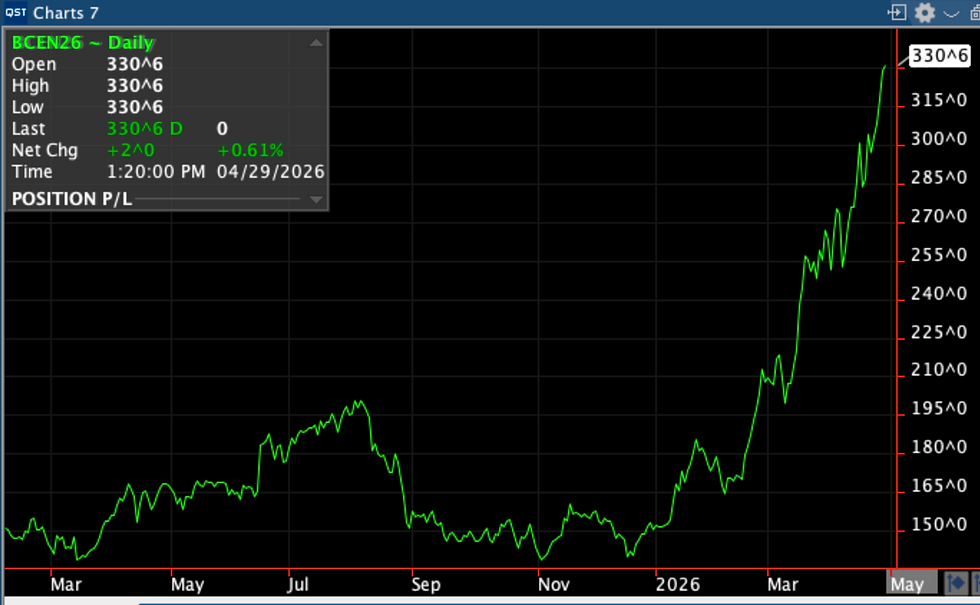
The arbitrage signal is becoming more visible. The FOB spread between South America and the U.S. Gulf has widened to roughly $500 to $525/mt, with South American soybean oil near $1,200/mt versus U.S. values closer to $1,700/mt. Even after accounting for a 19.1 percent import duty and an additional 10 percent Section 122 tariff, the gap remains large. This is why the back end of the soybean oil curve is not following the front higher. The market is starting to price the possibility of imports capping the rally.
This highlights the growing disconnect. The U.S. is not short feedstock. It is pricing policy. The RFS structure has created a domestic pricing island where soybean oil trades at a large premium to global values. FOB Paranaguá soybean oil remains deeply discounted, with levels between -1,950 and -2,200 versus CBOT. Global supply is available, but access to the U.S. market remains constrained.
At the same time, the structural role of biofuels in the energy system is becoming clearer. EIA data shows biofuels account for about 2.6 quadrillion Btu, or roughly 29 percent of total renewable energy consumption in the U.S., making it the largest renewable source ahead of wind and solar. With higher RFS mandates in place for 2026 and 2027, biofuels are now fully embedded within the refining system. They are no longer a marginal blending component. They are part of the supply stack. Without these mandated volumes, the loss of bio-based barrels would need to be replaced by incremental refining runs, which would push distillate cracks and outright prices materially higher than current levels.

The result is a split market. Diesel and jet fuel are tight and driving the complex. Biodiesel is following that strength through structure and credit support. Feedstocks globally remain long and discounted. As long as gasoil maintains backwardation near +400/mt, biodiesel premiums will remain supported. The pressure point is the back end, where softer spreads and import parity are already signaling that the current dislocation has limits.
The bottom line is clear. The front end remains under severe stress, driven by real supply disruption and reduced liquidity from holidays. The back end is starting to question how long this can last.


Comments