Energy Shrugs Off an 11.4M-Barrel EIA Build as Three Carriers Converge on the Arabian Sea and RFS Flex Caps RINs

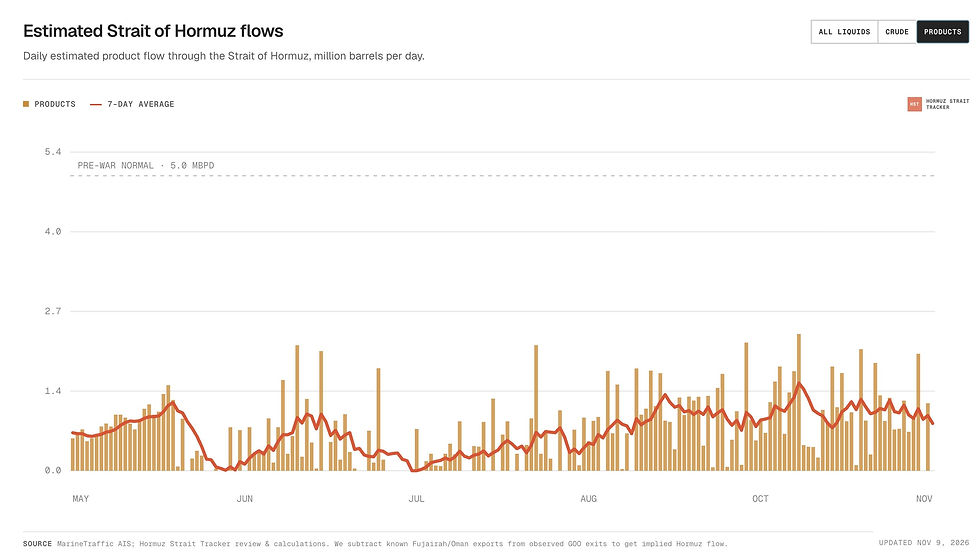
Geopolitical escalation completely overpowered what should have been a heavily bearish holiday-delayed EIA inventory report at noon Eastern today, lifting crude and refined products even as hawkish Federal Reserve chatter drove the US dollar index (DXZ26) up 0.28% to 103.110, pulled the euro down to 1.1066, and knocked February gold down $112.10 (-2.78%) to $3,921.20 per ounce. For the week ending November 6, the EIA reported commercial crude stocks jumping +4.7 million barrels to 414.4 million (4% below the five-year average, defying consensus for a 1.1-million-barrel draw), gasoline rising +1.8 million barrels, and distillate inventories surging +4.1 million barrels—lifting US distillates back above the 103-million-barrel mark as part of an 11.4-million-barrel total petroleum build. Yet instead of selling off, December WTI climbed $1.67 (+1.93%) to $88.20 per barrel, January Brent rallied $2.60 (+2.80%) to $95.36 per barrel, December RBOB gained 4.79 cents (+$16.87/mt) to $2.6554 per gallon (~$935/mt), and December NYMEX heating oil rose 4.65 cents (+1.10%, or +$14.55/mt) to $4.2578 per gallon (~$1,333/mt), holding the live heating oil crack above $90 at $90.66 per barrel. Even with OPEC October production recovering toward 27.16 million b/d via shipping workarounds, physical war risk kept bids underneath the barrel: UKMTO verified two more tanker strikes in the Arabian Gulf and off Ra's al Khaymah (including crew casualties evacuated ashore on November 10), Washington extended the USS George H.W. Bush carrier deployment past the holidays as a third strike group closes in on the northern Arabian Sea, Iranian state-linked media warned that reviewing an NPT exit is now an "unavoidable necessity", and Ukrainian drones struck Russia's largest refinery at Omsk (21–22 Mt/yr) for over eight hours—threatening Russia's 2.15-million-tonne November diesel export plan just a week after the US ranked as the top destination for Russian diesel cargoes.

In Europe, expiring November ICE gasoil (GASX26) unwound $28.25 (-2.11%) into contract termination to $1,313.00 per tonne—slashing the Nov/Dec gasoil backwardation by $23.00 to +$39.75 per tonne and flipping the midday December gasoil-versus-ULSD spread (GASZ26 - HOZ26*300) negative by $19.20 to -$4.09 per tonne before deferred January gasoil (GASF27) clawed back more than $42 off its $1,194.25 intraday low to turn positive late at $1,237.00 per tonne (+$3.50). In today's physical ARAG barge window (against a $1,246.86/mt gasoil reference), prompt RME staged a sharp snapback across four barge deals (+$600 to +$644) averaging +$621.00 per tonne to lift flat-price RME by $37.86 to $1,867.86 per tonne, while three FAME 0 barges averaged +$173.67/mt ($1,420.53/mt flat, -$0.47 d/d) to widen the physical RME/FAME 0 spread back out to +$447.33 per tonne, and UCOME printed one barge at +$370.00/mt ($1,616.86/mt flat, holding UCOME/FAME 0 at +$196.33/mt). By contrast, physical HVO Class II suffered a heavy flush across five window deals (+$920 down to +$872, averaging +$885.80/mt), dragging flat-price HVO II down $119.29 per tonne in a single session to $2,486.40 per tonne and pulling SAF down over $206 to $2,619.99 per tonne. Meanwhile, European biodiesel paper liquidity looks remarkably healthy: Week 45 volume stood at 373.2 kt before today's session (107.0 kt UCOME, 95.7 kt HVO2, 86.5 kt RME, and 84.0 kt FAME 0), and adding today's brisk 125.3 kt of paper turnover—led by 80 kt of HVO II selling off ($25–$30/mt lower in Feb and Q2 at +$1,350 and +$1,370/mt), 27 kt of firmer UCOME (Q1 +$10 to +$450/mt), 9 kt of Q1 RME (+$325/mt, even after Dec RME swaps tumbled $170 to +$420/mt and cut Dec paper RME/F0 to +$240/mt), 6 kt of FAME, and 3.3 kt of Q1 SAF at $1,200/mt—lifts Week 45's four-day running tally near ~498 kt, right on pace with Week 44's 654.9 kt and Week 43's 579.4 kt. Supporting deferred crushers as spot FAME/SBO hovers near -$4 to -$5/mt (and spot RME/RSO near $369–$464/mt), the Rhine at Kaub jumped 27 cm today to 43 cm (dropping low-water container surcharges a tier to €775/€930 ahead of a projected 71–83 cm weekend plateau as Alpine snowlines fall to 700–900 meters), while Dutch FOB mill rapeseed oil held its €100/t Nov/Dec inverse (€1,400 vs. €1,300/t) and gained €7–€10/t in Q1 '27 (€1,280/t Jan; €1,235/t Feb–Apr, behind €1,340/t Jan Dutch soyoil) after Matif rapeseed speculative net length nearly vanished to 536 contracts.

Across the Americas, updated public RFS balance-sheet analysis pegged required 2027 net D4 generation at 11.55 billion RIN gallons—or 963 million a month (~2.02 million mt/month physical equivalent)—against a 906-million-RIN monthly record, ~878 million a month of EIA domestic operable capacity, and a 682-million Jan–Sep 2026 pace (putting 5 billion to 14 billion pounds, or 2.27 million to 6.35 million tonnes, of feedstock at stake behind Gulf governors' waiver petitions), yet an invited Bloomberg webinar I attended today pointed to four practical conclusions explaining why compliance credits are not exploding higher. First, a haircut to the overdue 2028 Set 3 RVOs looks likely, trimming headline mandates by the import volumes effectively walled off by 45Z and proposed half-RIN rules while keeping domestic targets whole; second, D4 RINs look overpriced with December 2026 at $2.037 and December 2027 flat at $2.040 (already equating to well over $3.00 on a $3.00/gal diesel baseline), because carrying an RFS deficit carries zero financial penalty and multi-refinery operators can alternate deficits across separately registered plants to defer roughly half their obligation; third, the EPA's interpretation of EIA data remains a chronic flaw—underestimating consumption in 2025 only to overestimate 2026 obligated fuel at 180.6 billion gallons (~577 million mt) while missing demand erosion and refinery yield shifts from obligated ULSD into non-obligated marine high-sulfur distillate; and fourth, the panel essentially agreed that while the RFS is here to stay, industry can count on wide regulatory flexibility via deadline extensions and deficit rollovers. Against that backdrop, CME December soybean oil (ZLZ26) fell 61 points (-0.95%) to 63.27 cents per pound ($1,394.63/mt), compressing December BOHO by 9.60 cents (-16.56%) to +48.37 cents per gallon (~+$151/mt) and December BOGO by $8.64 to +$121.16 per tonne (109.34% of gasoil)—vaulting the screen December RD crush margin up 10.27 cents (+10.92%) back above a dollar to $1.0434 per gallon (~$339/mt) and the conventional biodiesel crush up 9.65 cents (+5.12%) to $1.9823 per gallon (~$594/mt). Notably, 2027's drop in standard RD equivalence values from 1.7 to 1.5 hands nimble 1.5-EV standalone biodiesel plants a major relative boost just as an idled Ralston, Iowa FAME plant prepares to restart against operable US capacity below 2.0 billion gallons (~6.67 million mt), US Gulf UCO dipped 1.25 cents to 69.5¢/lb (~$1,532/t) alongside US spot RD at $3.529/gal (~$1,147/mt), Argentine crushers unveiled a 15,000 mt/day Timbúes joint venture, and Brazil projected completing B20 technical studies by February 2027 (potentially absorbing 25%–32% of global ending soyoil stocks). Brazil is definitely getting ready for a big soybean crop.

In Asia, palm oil extended its rebound as 2027 Southeast Asian supply warnings clashed with elevated near-term inventories, while long-term aviation mandates highlighted structural waste-oil deficits. Most-active January BMD crude palm oil settled up 0.57% at 4,410 ringgit per tonne (with Q1 '27 USD swaps gaining $7.50 to $1,160.75/mt and re-inverting the Q1/Q2 spread back to +$5.00/mt), pulling live December BOPO tighter toward ~$264–$272 per tonne while prompt November and December POGO remain deeply negative (-$150.50/mt to -$258/mt on spot/Nov benchmarks and -$92.50/mt to -$165/mt in Dec) before flipping positive in Q1 '27 (+$3.75/mt). Speaking in Bali today, Indonesian palm industry officials warned that El Niño weather impacts could strip 3 million tonnes from Indonesia's 2027 output even before accounting for nearly 2 million tonnes of exportable supply absorbed by B50 ambitions yet Indonesia govt announced that they are sticking to 40%. Further north, Japan's METI outlined a proposed 1% international SAF mandate by 2030 rising to 5% by 2032 (~327,000 mt) where domestic UCO can cover only ~40% of required volume, East China domestic UCO slipped ¥50/t to ¥7,400/t standard as northern processors paused buying, and USDA confirmed another 136,000-tonne US soybean flash sale to China for 2026/27 right as Beijing urged Washington to implement their $60 billion reciprocal tariff-cut arrangement ahead of the APEC summit.
Looking ahead, our primary prognostication centers on an acute military flashpoint in the Middle East—and options positioning confirms institutional desks are braced for an upside tail event: with three US aircraft carriers now converging in the Arabian Sea and the combined operational and economic burn rate of enforcing the Iran naval blockade approaching $1 billion per day, this weekend opens again a very dangerous kinetic window. Sustaining a three-carrier posture indefinitely at that cost while tankers keep hitting mines and Tehran threatens an NPT exit is fiscally and militarily untenable—explaining not only why crude and NYMEX heating oil rallied straight through an 11.4-million-barrel EIA build today, but why January 2027 ICE gasoil options (GASF27, underlying $1,237.00/mt) still carry 10,482 contracts (over 1.04 million tonnes) of sticky call open interest stacked from $1,200 to $2,000—including 2,050 lots at $1,600, 1,800 at $1,700 (where another 50 lots traded today alongside 450 calls across $1,200–$1,300), and 1,000 lots at $2,000—at extraordinary implied volatilities ramping from 55.9% near-the-money up to 65.8% at $1,700 and 73.7% at $2,000. In vegetable oils, meanwhile, the stark kink on the Chicago soybean oil forward curve—where Dec26/Jul27(ZLZ26/ZLN27) deepened to a cycle-wide -1.39-cent contango while Jul27/Dec27 (ZLN27/ZLZ27) clings to a +1.05-cent backwardation—looks increasingly vulnerable in the back end: assuming South America's bumper crop materializes as advertised (with Brazilian AMJJ basis already at -1250/-1310) and both mineral diesel cracks ($90.66/bbl, or far steeper if this weekend's kinetic window ignites) and conventional biodiesel margins ($1.98/gal) remain strong, heavy 2027 processor runs will cap any July '27 scarcity hump and erode that Jul/Dec 27 inverse toward carry alongside tomorrow's USDA export sales, November soybean expiry, next Thursday's final 2025 EPA compliance data, and the December 4 SRE reallocation comment close.


Comments