Gasoil's 20-Day Moving Average Breaks the 50-Day as WASDE Lifts Soyoil, Blowing Out BOGO and Pushing Screen RD Crush Under $1.00/gal

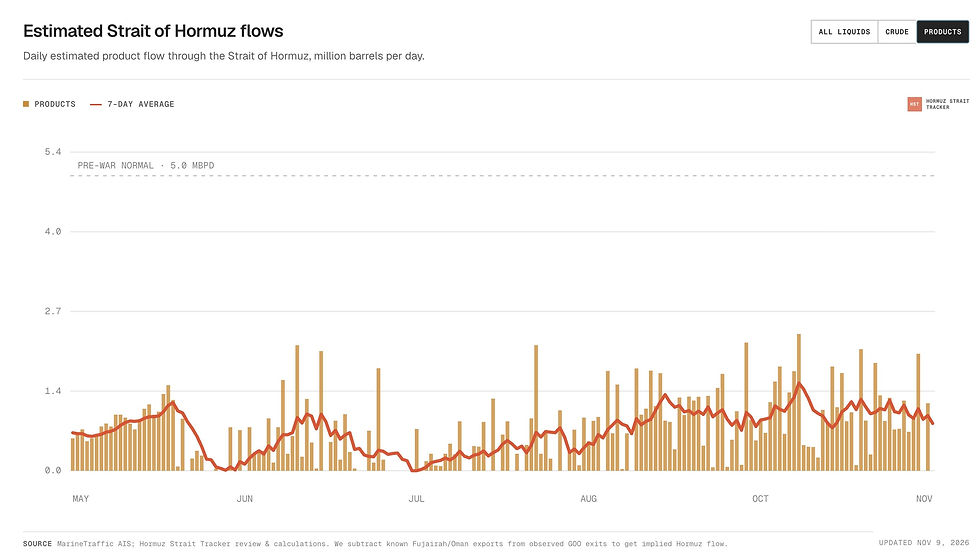
Energy futures extended their two-week slide today as diplomatic headlines and easing upstream outages extracted more war premium from flat price, even as today's EIA November Short-Term Energy Outlook (STEO) warned that refined fuel supplies will stay tight through end-2027—hiking its 2027 US retail diesel forecast by 54 cents to $5.03 per gallon and noting US commercial crude stocks ended October at a post-2014 low of 410 million barrels. January Brent briefly dipped below $90 per barrel for the first time since August before settling down $1.03 (-1.11%) at $91.54 (well beneath the EIA's $97.44/bbl 2026 spot forecast), December WTI slipped $1.02 (-1.17%) to $85.83, December RBOB fell 4.57 cents (-1.72%) to $2.6052 per gallon, and a 0.61% rise in the US Dollar Index to 102.150 knocked February gold down $77.40 (-1.87%) to $4,071.00 per ounce. Prompt November ICE gasoil plunged $54.25 (-4.07%) to $1,279.25 per tonne (narrowing Nov/Apr backwardation by $20.00 to +$177.75/mt, with December down $43.00 to $1,228.25/mt) and December NYMEX heating oil fell 7.90 cents (-1.87%) to $4.1358 per gallon—pulling the daily heat crack to $87.87 per barrel and the monthly 3-2-1 crack down $18.01 from its war peak to $45.02 per barrel. Paper sellers leaned on the EIA estimating that unplanned global liquid outages eased from 8.66 mb/d in September to 7.36 mb/d in October, Qatari Prime Minister Al Thani telling G7 ministers in Paris that Doha secured "at least two weeks" for US–Iran diplomacy, and four hours of Day 1 talks in Abu Dhabi where Kyiv pushed for a Black Sea and energy ceasefire. Yet physical reality remains starkly disconnected from paper peace: US national average retail diesel sits at $6.1572 per gallon ($2.18/gal above sub-$4 regular gasoline at $3.9788), direct Strait of Hormuz product flows remain choked near ~1.0 mb/d versus 5.0 mb/d pre-war (with overall Persian Gulf product flows stuck near 35–40% of normal), and Chinese GACC customs data showed net product exports tumbling from ~1.3 mb/d in September back to ~475–500 kb/d in October as Chinese commercial diesel stocks fell to a six-year low near 80 million barrels. While seaborne middle-distillate exports outside Russia hit a record 10.2 mb/d—led by a 500 kb/d Saudi Red Sea surge and refinery restarts in the UK and Japan that pulled Asian gasoil cracks toward ~$59/bbl—three straight days of unconfirmed Houthi strike claims, culminating in today's claim against Saudi Arabia's 7 mb/d East-West pipeline and the Abqaiq processing complex, squarely threaten the Red Sea bypass keeping total effective Gulf liquids exports at 18.7 mb/d (93% of normal) which is quite remarkable.
In Europe, waste-based UCOME led both the physical barge window and paper swaps today, rallying outright even as plunging ICE gasoil dragged crop-based biodiesel and HVO flat prices lower. Against a $1,215.00 per tonne ARAG window gasoil benchmark (down $58.25 from Monday), a physical UCOME barge traded at +$400.00 over gasoil—a $70 per tonne single-day jump in the physical premium that pushed flat-price UCOME up $11.75 to $1,615.00 per tonne and blew the UCOME/FAME 0 spread out by $65 to +$215.00 per tonne. Physical RME printed five window deals between +$645 and +$700 averaging +$664.00 per tonne ($1,879.00/mt flat, -$32.25 d/d), widening the physical RME/FAME 0 spread to +$479.00 per tonne as FAME 0 traded once at +$185.00 per tonne ($1,400.00/mt flat, -$53.25 d/d). HVO Class II traded twice at +$960 and +$955 for a +$957.50 average ($2,543.81/mt flat, -$66.31 d/d) with SAF assessed at $2,764.96 per tonne, right as SAF production margins for US and Chinese exporters selling into Europe flipped negative to -$32 per tonne (down from +$450/mt a month earlier) with much of Europe's 2026 mandate demand already pre-bought. That physical UCOME bid spilled aggressively into European paper swaps across 136.3 kt of volume: UCOME outrights surged across 72 kt—with December up $57 to +$447/mt, Q1 '27 climbing $50 to +$495/mt on 46.5 kt, and Q2 '27 rising $39 to +$569/mt—while Cal '27 UCOME/RME traded 24 kt at +$138/mt and Q1 UCOME/FAME printed 18 kt at +$210/mt, whereas Q2 '27 RME/FAME collapsed $53 to +$47/mt (with Q2 RME down $21 to +$409/mt and Dec HVO II off $10 to +$1,380/mt). In European cash soft oils, Dutch FOB rapeseed oil eased €10 in November to €1,400/t while holding unchanged in December at €1,300/t (with Feb–Apr '27 down €5 to €1,218/t and Jan Dutch soyoil steady at €1,315/t), and EU North Ports December sunflower oil rose $10 to $1,420/t even as Ukrainian agriculture ministry figures showed the sunseed harvest reaching 92% completion at 10.7 million tonnes (+23% YoY). On the Rhine, the Kaub gauge troughed at 12 cm today, though heavy southern German rain propelled upstream Maxau up 48 cm in 24 hours to 345 cm, prompting German federal waterway and hydrology agencies (ELWIS and BfG) to lift Kaub's Friday forecast to 57 cm and its weekend median to 69–81 cm.

In the US and across the Americas, a bullish November USDA WASDE surprise caught grain and oilseed bears leaning the wrong way, lifting Chicago bean oil into a falling distillate tape and knocking screen renewable diesel crush margins back below $1.00 per gallon (~$341/mt). Rather than validating market talk of a 55.0 bpa (3.70 mt/ha) US soybean yield, the USDA nudged yield up just 0.2 bpa to 53.3 bpa, or 3.58 mt/ha—below the 53.5 bpa (3.60 mt/ha) consensus, putting total output at 4.574 billion bushels (124.48 mmt). On the demand side, the agency raised soybean exports by 25 mbu (0.68 mmt) to 1,720 mbu (46.81 mmt) alongside a steady 2,780 mbu (75.66 mmt) domestic crush, cutting US soybean carryout by 15 mbu (0.41 mmt) to an even 300 million bushels, or 8.16 mmt (6.5% stocks-to-use, season-average farm price at $12.10/bu or $444.60/mt, and world carryout down to 123.50 mmt), while a 1.6 bpa (0.10 mt/ha) corn yield cut to 179.6 bpa (11.27 mt/ha) trimmed corn production by 141 mbu (3.58 mmt) to 15.893 billion bushels (403.70 mmt) and slashed US corn carryout by 91 mbu (2.31 mmt) to 1.758 billion bushels, or 44.66 mmt, leaving ethanol corn use unchanged at 5,650 mbu (143.52 mmt). With US soyoil stocks already sitting at a post-2014 low of 0.66 million tonnes and growing volumes effectively tucked inside RD supply chains, CME December soybean oil climbed 0.71 cents (+1.14%) to 62.74 cents per pound ($1,383.17/mt; Jan +0.71¢ to 62.90¢ or $1,386.91/mt, holding the Dec/May carry at -1.15¢ and Dec board crush near $2.055/bu or $75.51/mt, while Dec South American FOB soyoil stood near -880 points as official Brazilian data showed early-November daily vegoil exports up 225% YoY to 13,414 mt/day). With bean oil rising against falling distillates, December BOHO jumped 13.53 cents (+30.92%, or +$40.59/mt on a screen basis) to +57.27 cents per gallon (~+$171.81/mt; Jan +13.09¢ to +68.39¢/gal, or ~+$205.17/mt) and December BOGO rocketed $59.09 (+61.39%) to +$155.36 per tonne (putting bean oil at 112.52% of gasoil), dragging the December screen RD crush down 14.40 cents (-12.92%, or -$49.10/mt) to $0.9703 per gallon (~$330.87/mt; Jan at $0.8597/gal, or ~$293.16/mt) and conventional biodiesel crush down 13.68 cents (-$41.04/mt) to $1.9032 per gallon (~$570.96/mt, while US Gulf UCO held flat at 70.75¢/lb or ~$1,560/mt, and US cash RD and SAF eased to $3.693/gal or ~$1,259/mt and $6.036/gal or ~$2,100/mt, respectively). Compliance credits absorbed more of the margin load as D4 RIN futures climbed 2.01% in Dec '26 to $2.045 and 2.25% in Dec '27 to $2.055—shrugging off a November 9 petition to EPA Administrator Zeldin from Governors Kay Ivey (Alabama) and Jeff Landry (Louisiana) seeking a partial 2027 RFS waiver under Clean Air Act § 211(o)(7)(A)(i) "severe economic harm" (citing the EPA's $21.2 billion societal cost estimate versus $440 million in monetized energy-security benefits). Historically, the EPA is 0-for-4 on "severe economic harm" waiver petitions, though RIN desks should watch whether other Gulf Coast governors pivot to the lower statutory bar of "inadequate domestic supply" ahead of the EPA's December 4 SRE reallocation comment deadline (where Federal Register math puts biomass-based diesel's share at 0.30B/0.34B RINs for 2026/27 on an even split or 0.21B/0.43B weighted to 2027, even as a $915 million acquisition of 215 million gallons per year—~640 kt/yr—of US ethanol capacity underscored that 45Z and 45Q tax credits now account for roughly half of plant valuations).

In Asia, returning from Monday's Deepavali holiday, Malaysian palm oil tested critical YTD support—with spot November BMD touching 3,930 MYR/mt, just 7 ringgit above February's 3,923 YTD low—before reversing higher as official October MPOB stocks landed lighter than feared. While October end-month stocks rose 3.15% month-on-month to a seventh straight increase and a record 3.621 million tonnes, the MPOB print came in 129 to 139 kt below pre-report expectations (3.75–3.76 mmt) on a reported 55.75% jump in exports to 1.709 million tonnes (with biodiesel exports up 84.51% to 5 kt), 1.74% production growth to 2.154 million tonnes, and a 54.87% drop in imports to 26 kt with zero raw CPO imported. Frankly, however, that reported 1.709-million-tonne export surge—and the resulting stock moderation—warrants deep skepticism: it is highly suspicious to see Malaysian exports jump nearly 56% right while Putrajaya was openly considering removing its CPO export tax (giving buyers every incentive to delay liftings), raising real questions as to whether headline inventories were massaged to keep stocks under the psychological 3.75-million-tonne mark. That suspicion is reinforced by destination competition, where China is actively selling surplus soybean oil into India in direct competition with palm—keeping soybean oil cheaper than palm in Indian channels even after spot CFR WCI CPO dipped to $1,190/mt—while on Dalian, palm olein still trades above soybean oil, triggering at least two Chinese palm olein cargo washouts since Friday alongside a post-2023 October low in Chinese customs soybean imports. Even so, benchmark January BMD futures (KOF7) settled up 0.05% at 4,258 MYR/mt (USD/MYR 4.0573) and USD CPO swaps gained $4.75/mt in December ($1,090.00/mt) and $7.00–$7.50/mt in Q1/Q2 '27 ($1,119.50 and $1,120.75/mt), which alongside tumbling gasoil sent EOD palm-gasoil (POGO) swaps surging $100.25 in November to -$143.50/mt, up $85.50 in December to -$86.25/mt, and positive for Q1 '27 at +$0.50/mt (while screen Dec BOPO widened $15.65 to +$298.42/mt and Nov 1–10 Malaysian export inspections slipped 1.89% MoM to 515,157 mt). Looking into 2027, while Indonesian biodiesel mandate shortfalls and deferred El Niño yield risks remain on the radar, India's newly confirmed draft SAF policy—targeting 1% blending in 2027, 2% in 2028, and 5% in 2030 under fixed cost-plus pricing that bars crop feedstocks (corn, soy, palm) and floats a minimum support price for UCO—adds another structural lock on Asian waste oils alongside steady East China UCO (¥7,450/t standard, ¥7,750/t premium; $1,175/t FOB bulk).

Looking ahead, today's price action points to further downside in middle distillates and renewed macro pressure across biofuel feedstocks, confirming we should not have doubted the three-week technical lead-lag signal flashed by collapsing soybean oil last month. Roughly three weeks after January soybean oil's (ZLF27) 20-day DWMA (64.74¢) crossed bearishly beneath its 50-day DWMA (66.63¢, with both beneath the 67.77¢ long-term average), prompt November ICE gasoil (GASX26) triggered that exact same bearish crossover today as its 20-day DWMA ($1,402.30/mt) broke below its 50-day DWMA ($1,407.85/mt)—opening a technical path lower toward gasoil's long-term DWMA at $1,162.59/mt. Because physical supply remains indisputably tight—with the EIA estimating 7.36 mb/d of offline global liquids, multi-year-low US and Chinese diesel stocks, ~30% of Russian refining capacity hit, the Bayway refinery lockout on Day 23 ahead of a floated Nov 16–18 return, and NOAA/USACE river bottlenecks keeping Memphis at -2.28 feet for Day 17 below the low-water trigger (with Sunday's crest cut to 0.0 feet before sliding toward -5.3 feet by Dec 7, right as Smithland L&D closes the Ohio River this Saturday, Nov 14)—gasoil's technical breakdown alongside today's 200 kb/d EIA cut to 2027 oil demand tells us slowing global economic activity and industrial demand destruction are now overpowering physical scarcity. Consequently, unless tomorrow's Day 2 talks in Abu Dhabi collapse or Houthi strikes visibly sever Saudi Arabia's Red Sea pipeline flows, expect gasoil to grind lower—forcing D4 RINs above $2.05 and European biodiesel premiums like UCOME to shoulder even more of the compliance margin as screen BOHO and BOGO stay stretched. Options traders are positioning for that exact outcome on the January 2027 chains: while ICE January gasoil (GASF27, $1,189.00/mt) still carries lofty high-50s implied volatility (~57.2%–57.5% ATM) with 10,253 lots of sticky call open interest stacked from $1,200 to $2,000 as geopolitical tail insurance, January CBOT soybean oil (ZLF27, 62.90¢) sits in cheap low-20s implied volatility (~22.3%–23.1%), where desks used today's post-WASDE bounce to aggressively buy downside put protection at 60 cents and below—trading 5,022 lots on the 60.00-cent put alone (exceeding its 3,874 open interest) alongside fresh 57–59 cent puts in anticipation of the next macro leg lower possibly led by deteriorating Global trade conditions. Soyoil technical chart doesn't look good!


Comments