Diesel set for another squeeze into mid-month

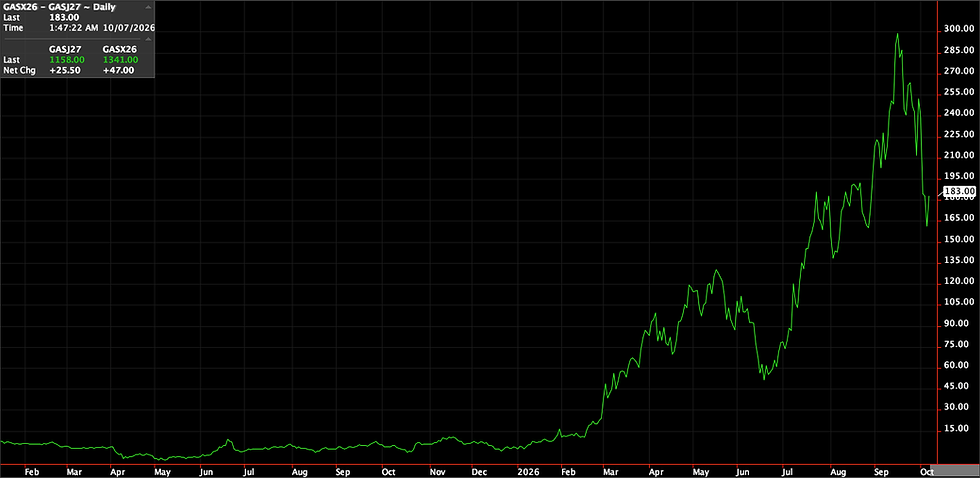
My call remains the same: diesel spikes into mid-month. October/January ICE gasoil stands at $157.75/tonne backwardation, while November/February still commands $135.25/tonne, showing that the nearby premium extends beyond October’s approaching expiry. Both spreads are below their September peaks, but the curve continues to price a substantial premium for earlier delivery. The nearby heating-oil/WTI crack is $112.19/bbl, calculated from heating oil at $4.8377/gallon and WTI at $90.99. December BOGO has compressed to +$114.81/tonne, using soybean oil at 67.77¢/lb and gasoil at $1,379.25/tonne. Renewed Middle East military fears add to the supply risk: US Treasury sanctioned another 17 Iranian shadow-fleet vessels today, while Turkey and Pakistan have agreed to rapid military deployment in support of Saudi Arabia. Their official statement does not establish participation in a new offensive against Iran.

NWE paper was active, with substantial losses in biodiesel premiums. The end-of-day tally recorded 85kt across FAME contracts and its calendar spread, 28kt tonnes in RME, 25,5kt in UCOME and 15kt tonnes in HVO II, alongside separate inter-product spread business. Q4 FAME’s last-traded/current value fell $67 to +$103/tonne over gasoil, Q4 RME lost $55 to +$260, and November UCOME fell $84 to +$211. Physical RME moved differently: the window outright average rose $56.05 to $1,834.60/tonne, while FAME fell $48 to $1,565 and UCOME slipped $27.25 to $1,661.50. That left physical RME/FAME at +$269.60/tonne. Winter-grade value strengthened in the physical window even as forward premiums retreated, making the distinction between outright prices and gasoil differentials particularly relevant today.

Asia returned from China’s Golden Week today with palm firmer, although the morning rally faded. December Malaysian palm settled at MYR4,645/tonne, up 2.67%, after reaching MYR4,684. The dollar swap curve put December palm at $1,197/tonne, up $24.50, while December POGO remained -$144.18/tonne below gasoil. Indian spot palm C&F nevertheless fell to $1,220/tonne, so the futures recovery was not matched across the physical market. China’s reopening may also bring movement on fuel export quotas, but with senior decision-makers not expected back until next week, I would not expect a rapid decision or count on immediate Chinese diesel supply relief. Fresh Chinese UCO offers are needed too: the available FOB indications predate the holiday and cannot establish today’s replacement cost into European UCOME or HVO production.

Hurricane Isaias makes this weekend critical for US diesel. By 11 a.m. CDT Thursday, offshore operators had shut in 1.28 million b/d of crude production, or 62.89% of Gulf output. The afternoon checks showed no confirmed refinery rate cuts, leaving refinery operations, port access and product loadings as the next developments to watch through landfall. Norco and Geismar were outside the warning areas in those checks; a westward shift would bring Louisiana renewable-diesel capacity into closer focus. Separately, the intercepted Cuba-bound biodiesel leaves me scratching my head: roughly 620,000 gallons across 90 shipments, valued at nearly $3 million, with ISO tanks pictured. US sourcing plus tank hire, handling and equipment-return costs needs explaining when Asian biodiesel in flexibags would be an obvious significantly cheaper alternative on price. Buying domestic B99 with its RINs already separated does not remove the exporter’s retirement obligation on the renewable volume. Someone still has to absorb that cost. The valuation implies about $4.84/gallon, but the product specification, invoice and freight terms are needed before the economics make sense.
Weaker Paranaguá soybean-oil basis gives feedstock buyers another variable to work with: October 7 indications showed November at -1250 to 1350 under Chicago and December at -1220–-1350 under. Soybeans had recovered above $13/bushel on Tuesday, while USDA’s latest harvest count was 25% complete against a 33% five-year average, keeping tomorrow’s yield update relevant. Europe’s growing call on US supply also connects agriculture with energy. The US supplied 57.4% of EU LNG imports in the first quarter, while August US corn deliveries to the EU reached 1.24 million tonnes, the highest monthly total since June 1982. The corn surge is consistent with buyers seeking alternative origins as Ukraine’s Black Sea bottleneck constrains shipments; that same problem matters for sunflower oil availability and delivered soft-oil prices. With Europe also looking to US diesel as an alternative supply source, any storm-related interruption to American loadings would arrive at an awkward moment. That is why I still expect diesel strength into mid-month to keep pressure on BOGO, while freight determines how much cheaper feedstock at origin actually benefits biodiesel and renewable-diesel producers.



Comments