Diesel Won Q3. Washington Could Decide Q4

A quick publishing note: I will be out of pocket and moving to a non-daily posting schedule through October 10 depending on news
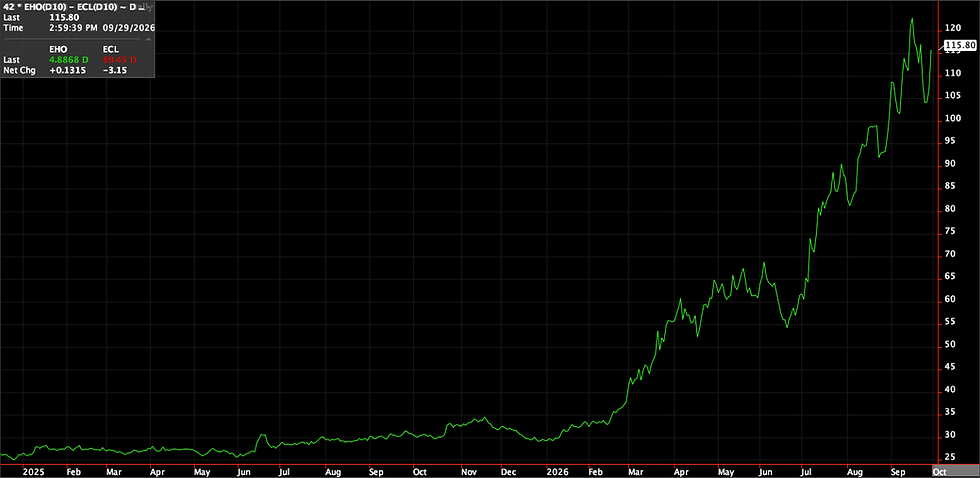
Wednesday, September 30 closes a quarter in which diesel appreciated much faster than soybean oil. In my June 30 note, the nearby heat crack stood at $69.89/bbl and the 3:2:1 at $62.23; today’s screens show $115.27 and $74.53 respectively. Those nearby-contract snapshots are approximately 65% and 20% higher, although contract rolls affect the comparison. December soybean oil provides a cleaner same-contract measure: 65.00¢/lb on June 30 against 68.28¢ today, an increase of just 5.0%. December D4 went the other way, falling from $2.442 to $2.064, down 15.5%. For biodiesel and renewable diesel producers, stronger fossil-diesel replacement value has had to compensate for weaker compliance value. That shift leaves the industry entering Q4 with greater exposure overall to whatever Washington does about diesel prices. Am inclined to think that a 90-day crude+refined products export ban is the most expedient way to lower prices at pump and rebuild US stocks.

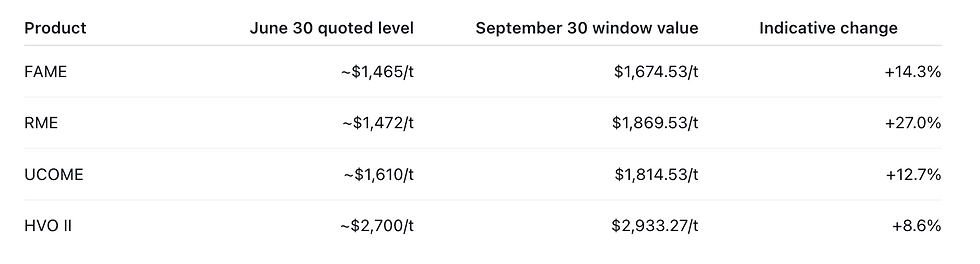
Northwest Europe illustrates the difference between outright appreciation and renewable premiums. Today’s physical-window values of approximately $1,870/t for RME and $1,815/t for UCOME compare with roughly $1,472 and $1,610 quoted in the June 30 post, indicative gains of about 27% and 13% rather than precise assessment-to-assessment returns. Today alone, October gasoil rose $75.25/t to $1,469.50, while October/December backwardation widened $25.25 to $122.25/t. Biodiesel premiums weakened against that rally: the end-of-day paper report showed October RME at +325, down $90/t, and October UCOME at +329, down $76/t. Asia is meanwhile heading into a quieter trading period, with China’s Golden Week running October 1–7, beginning tomorrow. Reduced Chinese participation should limit regional price discovery, so thin holiday trading will need care in interpretation. December palm’s latest settlement was MYR4,663/t on Tuesday, down MYR38. December BOGO today fell $51.76 to $158.05/t, with stronger gasoil accounting for $50 of the compression. Diesel continues to do most of the work in improving feedstock-versus-fuel economics.
The US inventory report makes that diesel strength harder for Washington to ignore. EIA’s September 25 balance shows distillate stocks falling 2.251 million barrels to 105.180 million, with almost 88% of the withdrawal coming from the 15-ppm-and-under pool. Refinery inputs dropped 554,000 b/d, and distillate inventories remain 14% below their five-year average. I expect this to intensify pressure for export restrictions in Q4, although that remains a policy risk rather than an announced ban. July distillate exports of 1.745 million b/d show the scale of the trade exposed. A ban could retain more barrels in the US and push domestic diesel prices lower, while reduced US availability could raise prices for European buyers. Asian suppliers could see additional demand for replacement cargoes. For renewable-fuel traders, the risk is that US diesel replacement values fall while overseas values rise.

October’s RVO timetable adds a second source of uncertainty. Tomorrow, October 1, remains EPA’s published compliance reporting deadline for the 2025 obligation, with no further extension announced as of September 30. Separately, EPA has committed to proposing, before the end of October, the reallocation into 2026 and 2027 of the difference between projected and actual 2025 small-refinery exemptions. Its published figures are 1.76 billion exempted RINs against 990 million already anticipated, leaving approximately 770 million RINs to address. The end-October commitment concerns a proposal, not a finalized additional obligation; the allocation between years and fuel categories will determine its relevance to near-term biodiesel and RD demand. As we discussed in August, changing the compliance calendar can move RIN prices without immediately changing physical production. Traders therefore face both the completion of 2025 compliance and a pending decision on how much additional demand falls into subsequent years.
An export ban could itself increase RIN obligations, separately from that SRE reallocation. Petroleum diesel exported outside the US is excluded from the domestic RVO calculation; if a ban redirects those gallons into the covered US fuel market, they become subject to renewable-fuel obligations. More domestic supply could push US diesel prices down, while additional compliance demand could push RIN prices up. The net increase in obligations would depend on whether retained barrels replace imports or other domestic supply. Allowing red-dyed diesel, generally associated with off-road use and different tax treatment, into road vehicles does not automatically remove renewable-fuel obligations. Washington could therefore find that retaining diesel to lower pump prices adds RIN costs to those same barrels. Q4 domestic volumes would affect 2026 obligations, not the 2025 deadline falling tomorrow. After Q3’s rally, I would manage diesel and RIN exposure separately: an export restriction could lower the product value supporting US biodiesel and RD margins even as it increases demand for their compliance credits.


Comments