Diesel Prices a Winter Squeeze. Vegetable Oils Prices Ample Supplies

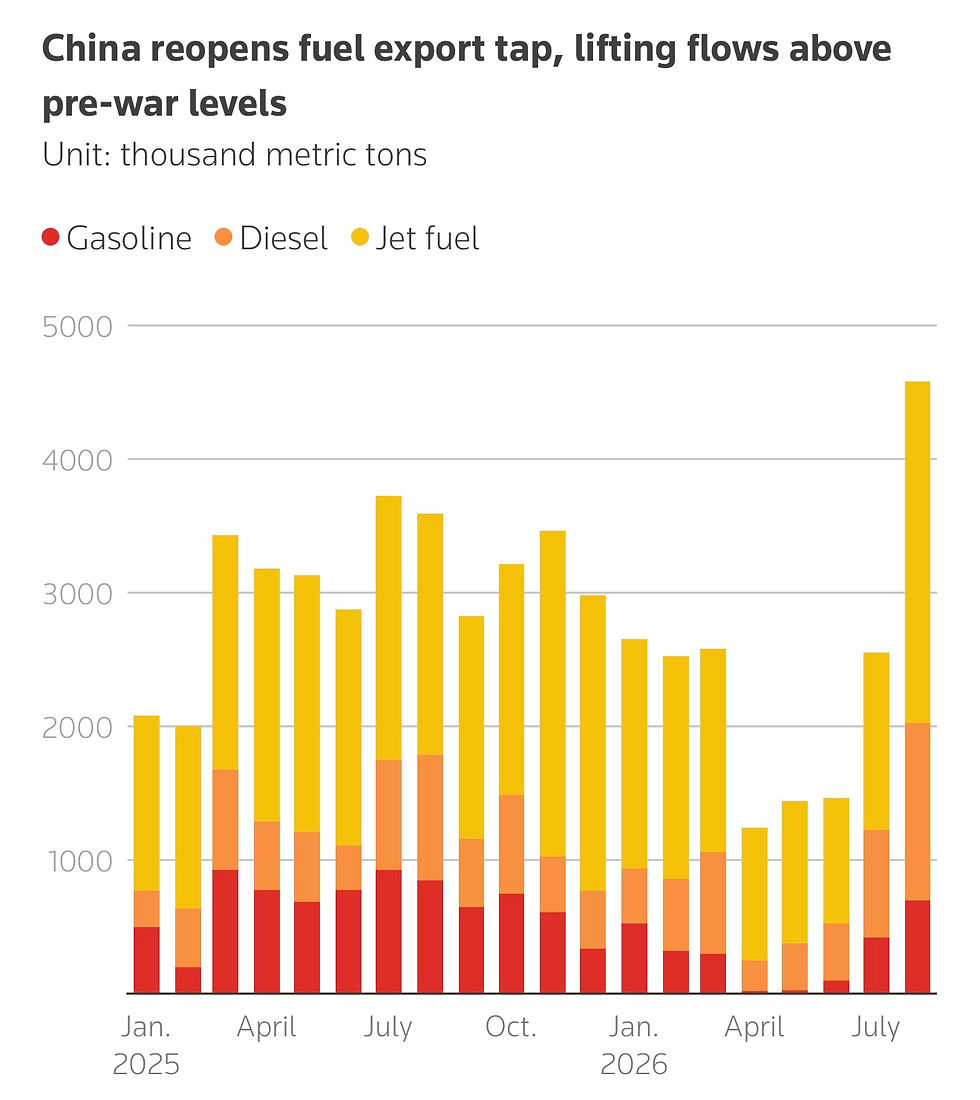
December/April gasoil is the most disturbing chart today. December at $1,333/mt against April at $1,142 puts backwardation at $191/mt, widening $15.25 on the session as December gained $27.25 and April rose $12. October/January also stands around +$190.50/mt. December fuel commands 16.7% more than April, extending the strength well beyond October delivery. Meanwhile, November Brent traded around $99.15/bbl, down $1.19, as October gasoil gained approximately $26/mt. That divergence keeps me bullish diesel and skeptical of pricing physical relief ahead of the September 24 China summit. My personal expectation is for limited initial results; with winter gasoil still commanding $191/mt over April, I want quantified commitments, shipment dates and additional supply before changing that view.

Northwest Europe’s biofuel prices show a divided response with Rhine river constrained logistics. October RME paper premium reached $405/mt, up $55, and October FAME reached $290, up $45, while October HVO II premium fell $75 to $1,585. September UCOME rose $75 to $450. Conventional biodiesel premiums therefore strengthened while the October renewable diesel premium weakened. In the physical window, RME was approximately $1,888/mt, FAME0 $1,802, UCOME $1,902 and HVO II $3,000. On that common window basis, RME commanded about $86/mt over FAME0, UCOME about $100, and HVO II roughly $1,098 over UCOME. Inland conditions added another constraint: Kaub fell from 16 cm Monday afternoon to 10 cm Tuesday afternoon. That further 6 cm decline reinforces the importance of delivered pricing when the winter gasoil curve already carries a $191/mt premium.
In the United States, soybean oil is sending the opposite calendar signal. October at 67.35¢/lb against January at 68.15¢ leaves October/January at −0.80¢/lb, equivalent to approximately $17.64/mt of carry. December at 67.92¢ against March at 68.38¢ puts December/March at −0.46¢, or about $10.14/mt of carry. Weakness therefore extends beyond October. USDA’s soybean harvest progress of 12%, against 8% a year earlier, provides a concrete supply consideration alongside those spreads. December D4 RINs traded at $2.09, up 2.63%, while December soyoil on the later spread screen was down 0.93¢/lb. An earlier afternoon snapshot put October BOGO near +$17/mt, December +$165 and January +$230. January’s roughly $213/mt wider BOGO than October shows how sharply the feedstock-versus-fuel comparison deteriorates forward, before conversion costs, physical basis and other credits.

Asia extends that comparison through POGO. September 22 indications put palm oil against gasoil at approximately −$157/mt for October and −$86 for November, versus only −$13 for the widely traded December contract. October’s raw-material discount is therefore roughly $144/mt larger than December’s; nearby economics cannot simply be extended into year-end production. Although the palm oil reference is always 3rd month. December Malaysian palm oil closed at RM4,810/mt, down RM47, while September 1–20 export estimates were 12.8%–24.7% below the corresponding August period. Chinese palm inventories of approximately 890,000 tonnes on September 20 provide another measure of nearby availability. Demand is not uniformly weaker: Indian August palm imports rose 7% month on month to around 783,000 tonnes. Alongside April gasoil gaining $12 today, that increase argues against declaring a worldwide demand collapse from negative POGO and soyoil carry alone.

Options frame the risk into early October. December gasoil implied volatility was approximately 56% near the $1,350 strike and 59%–60% at $1,450–1,500, against roughly 26%–29% for December soybean-oil calls across 70–80¢ strikes. Gasoil’s displayed volatility was around twice soyoil’s. The $1,450 gasoil call had approximately 2,200 contracts open, while soyoil had about 39,600 at 75¢ and 11,900 at 80¢; those counts do not establish who is net short. My personal forecast is that renewed military escalation involving Iran could emerge in early October. That is a judgment about the risk, not a conclusion proved by the prices. With December/April already at +$191/mt, further disruption would meet a market paying heavily for winter availability. I remain bullish diesel, but sustained narrowing from that $191 level, accompanied by inventory builds and higher product flows, would challenge my view.


Comments