China Opens the Fuel Tap To Save US, but Replacement Diesel Faces New Obstacles

China provided meaningful relief in August, exporting 1.33 million tonnes of diesel, up 42.1% year on year, and a record 2.55 million tonnes of jet fuel, up 41.4%. Those combined 3.88 million tonnes of middle distillates matter against reduced Russian product availability. Reported attacks on three Russian refineries—Slavyansk, Taneco and Syzran—add to the production pressure, while an extension of Russia’s producer diesel-export restrictions from September 30 through October remains reported but not formally confirmed. Europe also faces reports that at least two refiners will receive no October Saudi crude following the East–West pipeline attack. Can China keep filling the gap? Its January–August refined-product exports were still down 9.6%, so August’s recovery has not erased the earlier shortfall. I would look for another month of sustained exports and actual cargo arrivals before assuming the replacement problem is easing.
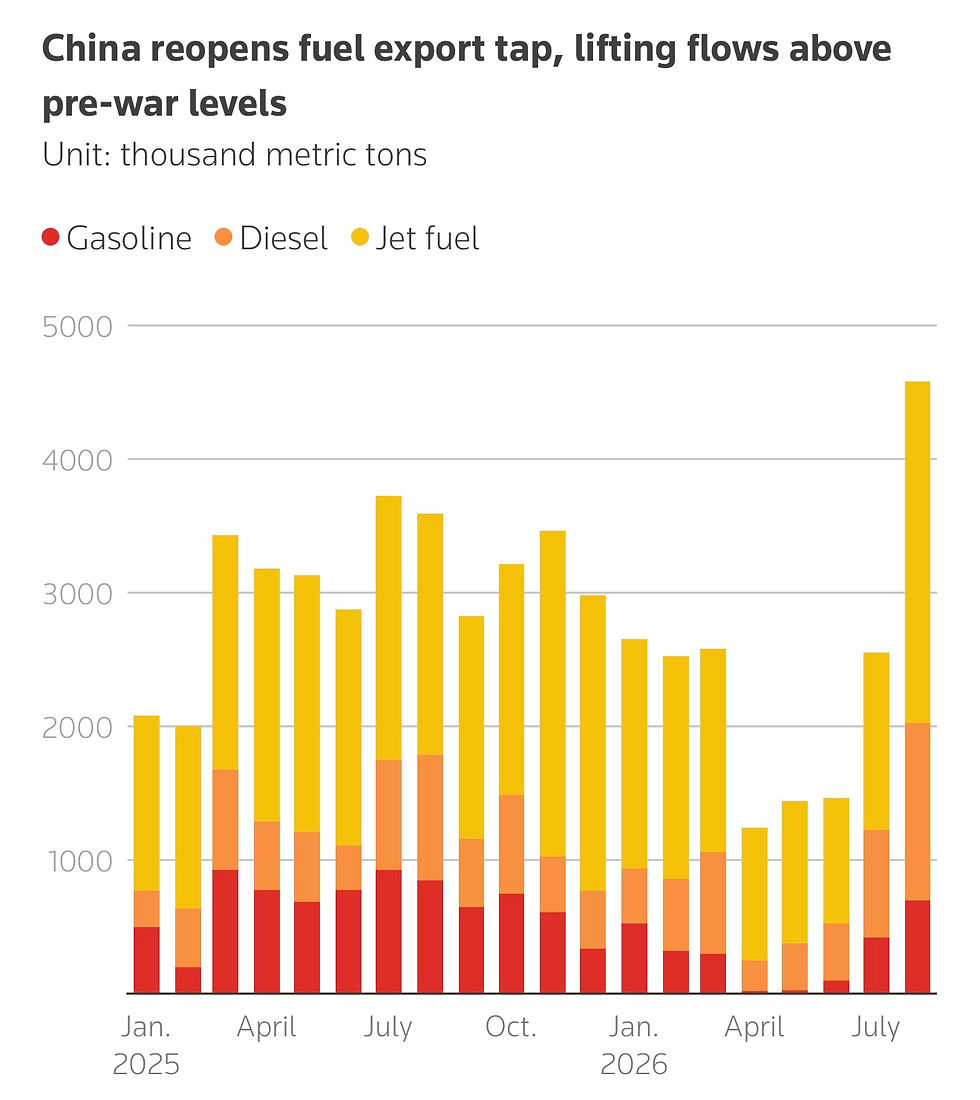
The Lindsey Graham sanctions legislation adds pressure on the refiners Europe needs to supply those replacement products. Passed by the House on September 16 by 262–159 and sent to President Trump, the bill provides for tariffs of up to 100% on U.S. imports from qualifying major buyers of Russian energy. Estimated August Russian crude purchases of 1.6 million b/d by India and 1.1 million b/d by China put a combined 2.7 million b/d potentially under that pressure. Enforcement and waivers will determine the effect, but replacing Russian feedstock could raise costs and weaken export economics. With Brent around $106/bbl on September 17 and U.S. retail diesel reported at $6.31/gal, replacement already carries a substantial price tag. If dirty freight Tankers remains elevated, lower Arabian Gulf FOB crude differentials could help preserve Eastern refiners’ incentive to run. The September 24 Trump–Xi meeting therefore matters for both energy flows and trade policy, although diplomatic progress would not immediately restore the product availability affected by those three Russian refinery attacks.
European physical biodiesel activity remained light, with Friday’s window recording one transaction each in RME, UCOME and HVO Class II and no FAME0 deal. Reported flat prices were approximately $1,942/mt for RME, $1,987 for UCOME and $3,142 for HVO2, while FAME0 was indicated near $1,820 and SAF around $2,935. HVO2 therefore stood roughly $1,155/mt above UCOME and $207 above SAF on the same sheet, although energy content, specifications and compliance treatment prevent a straightforward substitution comparison. Paper activity tells a more active story: HVO2 turnover totalled 1.277 million tonnes across the six tracked periods, representing 33.6% of combined RME, FAME0, UCOME and HVO2 volume and leading in five periods. Through Thursday in the latest period, HVO2 reached 178.1 kt out of 550.4 kt, a 32.4% share. That establishes sustained trading interest in this expensive road-fuel benchmark, without implying that turnover equals physical consumption or net buying.

December BOGO is the more relevant feedstock benchmark for cargoes and production still being arranged. Friday’s screen showed December soybean oil at 68.22 cents/lb, equivalent to approximately $1,503.98/mt, against December gasoil at $1,338.50, leaving BOGO at $165.48/mt. That was a narrowing of $20.75/mt on the day, or 11.1%, improving the feedstock-versus-fuel comparison for year-end business. October’s near-parity spread is less useful for new commitments with delivery only weeks away. The forward distinction remains important: January BOGO was around $233/mt and March $325, roughly $67 and $159 above December respectively. Palm indications similarly placed Q4 POGO near minus $141/mt versus plus $66 in Q1. These are feedstock comparisons rather than realised production margins, with conversion, yield, physical basis and freight still to cover. Inland delivery adds another cost: Kaub stood at 20 cm on September 18, while the latest available Rotterdam–Karlsruhe tanker freight reference was €165–170/mt, dated September 11.

China’s agricultural purchases add another timing issue for renewable-fuel feedstocks. USDA data put U.S. soybean export sales through September 10 at 20.6 million tonnes, covering 45% of the annual forecast, with China explicitly accounting for 48%; Friday brought another announced Chinese purchase of 111,000 tonnes. Estimated Brazilian soybean loadings to China reached 69.0 million tonnes through September 16 versus 72.1 million a year earlier, down 4.3%, supporting an origin-shift interpretation without establishing weaker total demand. Indonesia’s forward balance also deserves attention: industry projections point to a 3% production decline in 2027 alongside roughly 3 million tonnes more domestic consumption and 5 million tonnes fewer exports. For year-end biodiesel and renewable diesel business, December BOGO near +$165/mt provides a more practical starting point than October’s near-zero spread, while March near +$325 shows how different later replacement economics remain. China’s 3.88 million tonnes of August diesel and jet exports have bought time; maintaining that relief while sanctions potentially pressure 2.7 million b/d of Chinese and Indian refinery feedstock is the next test.


Comments