top of page
Search

The Great Unwind: The Curve Doesn’t Lie as Diesel Structure Collapses and Soy Oil FreezesGeopolitics move, policy stalls, and biodiesel markets diverge across the Atlantic

ICE gasoil extended its extraordinary reversal today with Dec/Apr collapsing again to +29.75, now almost 70% lower than the +95 peak only two weeks ago. Moves of this kind simply do not occur without a major macro shift. There has been no surge in stocks, no sudden collapse in demand, and no supply wave to justify this. The curve is stripping out the wartime geopolitical premium, and doing so at remarkable speed. The confirmation comes from FX, with USD/RUB strengthening to ~76, a highly unusual move during an active conflict but entirely consistent with markets anticipating progress toward negotiation under the media blackout. The ruble and the gasoil curve are telling the same story: geopolitical de-risking is underway, even if official channels remain silent.

In Europe, ARAG saw another active session with refiners stepping in once more, reminiscent of the heavy flow seen in Week 47. RME traded near $1456/mt, yielding a replacement margin of roughly $200/mt, while FAME0 returned closer to $60/mt. UCOME remained the strongest at around $267/mt, supported by scarce Annex IX availability and the ongoing pull from RED III and emerging SAF obligations. These margins remain well above marginal operating costs despite Europe’s structurally inflated inputs — industrial power prices are still roughly double to triple pre-crisis levels, and catalyst costs are materially higher. Window and paper buying continues simply because compliance demand remains far more predictable than the diesel flat price environment.

European Bio Paper
European Bio Paper

European vegetable oil values softened slightly but stayed broadly stable, with Dutch soyoil for Feb26 near 1095 €/t (–5), German origin near 1105 €/t (–5), rapeseed oil holding 1077–1082 €/t, and sunflower oil steady at 1350–1360 $/t. Feedstock softness is incremental — the real driver is the sustainability attributes themselves. With mass balance tightening and waste/residue verification strengthening after last month’s ISCC working sessions, the premium now resides in eligibility rather than commodity movement. This structural tightening is precisely why HVO2 and biodiesel paper volumes remain elevated even as diesel structure collapses.


Paper spreads told the same story of divergence. BOGO firmed to around +475, up roughly 1.6 percent, reflecting the durable compliance pull in Europe. POGO held near +365, maintaining a tight palm pathway. BOPO, however, slid sharply toward +115, down more than 8 percent on the day — a direct expression of U.S. policy inertia. When Washington provides no clear signal on RFS volumes, 45Z implementation, or co-processing eligibility, BOPO has no reason to tighten. The spread’s weakness today matches the tone of soybean oil carry and confirms traders see no imminent regulatory direction.


Across the Atlantic, the U.S. biodiesel sector remains under severe pressure. The screen biodiesel crush margin sits around –40 c/gal, deeply negative and reflective of competition from renewable diesel, feedstock tightness, and an absence of federal clarity. In this context, a major California producer announced it will pause biodiesel production for at least the first half of 2026, keeping only a minimal team on standby. The pattern of idling is no longer cyclical — it is structural.

Biodiesel Screen Crush Margin

U.S. agriculture is experiencing the same stress. The administration is preparing a $12 billion support package for farmers as China continues to avoid U.S. soybean origins except when politically compelled. This occurs even as the USD strengthens and geopolitical risk fades — two developments that further weaken U.S. export competitiveness. U.S. soybean inspections remain historically weak despite China importing 8.11 million tons in November and 104 million tons year-to-date. To make politically driven U.S. purchases work economically, China increasingly exports soy oil, which aligns with deeply negative new-crop Paranaguá premiums around –580.


Meanwhile, the soybean oil forward curve remains frozen, with Jan/Jul around –$22/mt, equivalent to a full 1 c/lb contango and roughly half of that embedded through March. If markets believed any breakthrough was imminent on RFS volumes or 45Z guidance, this contango would have tightened sharply. Instead, it has barely moved. Soybean oil is effectively signaling policy paralysis: no clarity, no incentive, no front-end pull. Diesel structure collapses because geopolitics are moving; soy oil contango holds because U.S. policy is not. And as always, the curve doesn’t lie.

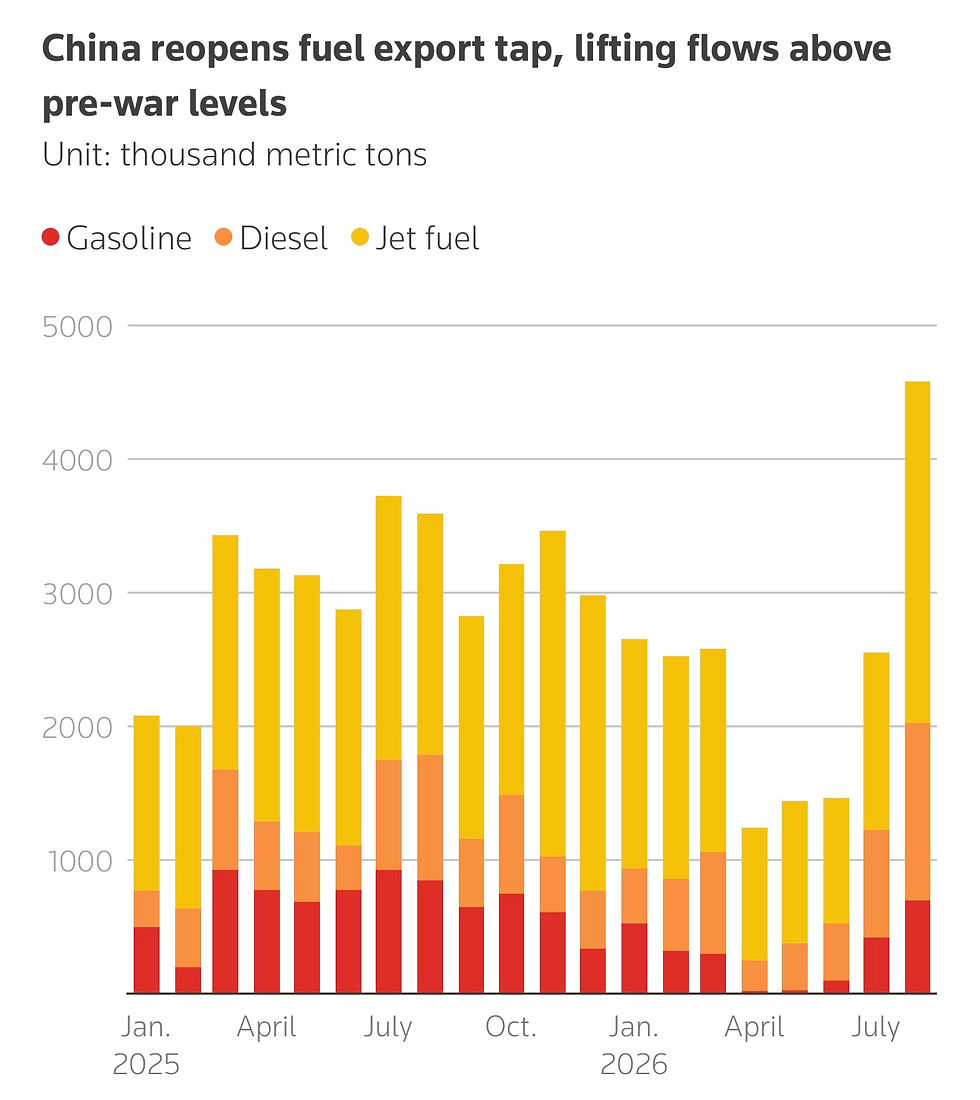
Asia’s middle distillates echoed the same unwind. Gasoil cracks stabilized around $21/bbl while differentials eased and jet regrade narrowed, consistent with a global reduction in risk premium rather than deterioration in underlying demand. China’s crude imports climbed nearly 5 percent year-on-year and India’s fuel consumption reached a six-month high, reinforcing that softness in structure is not demand-led but risk-led.


If the market’s signals prove correct and meaningful progress toward peace in Ukraine emerges, the implications for early 2026 diesel pricing are profound. A geopolitical détente would likely collapse diesel cracks outright, dragging down flat prices and compressing biodiesel replacement margins across Europe. Lower diesel values remove discretionary blending incentives and weaken physical pull. The collapse in backwardation may only be the first act — if cracks follow, biodiesel will feel the impact swiftly and decisively, especially in Europe where compliance demand has thus far masked the softness in underlying energy markets.


The biodiesel complex today is shaped by geopolitics moving abroad and policy failing to move at home. Europe operates within a disciplined and tightening compliance framework that continues to support physical and paper flows even as diesel structure weakens. The U.S. faces negative Biodiesel crush margins, paused biodiesel production, and soybean oil curves that openly reflect regulatory uncertainty. China’s political soy flows and South America’s deep discounts only widen the divergence. In the end, the market is responding not to fundamentals but to geopolitical recalibration, regulatory credibility, and the growing divide between Europe’s compliance-driven architecture and America’s policy paralysis.


Comments


©2022 by globalbiodiesel. Proudly created with Wix.com

bottom of page