RVO Decision Week Meets Energy Tightness as Vegetable Oil Abundance Builds
- Henri Bardon
- Mar 23
- 3 min read

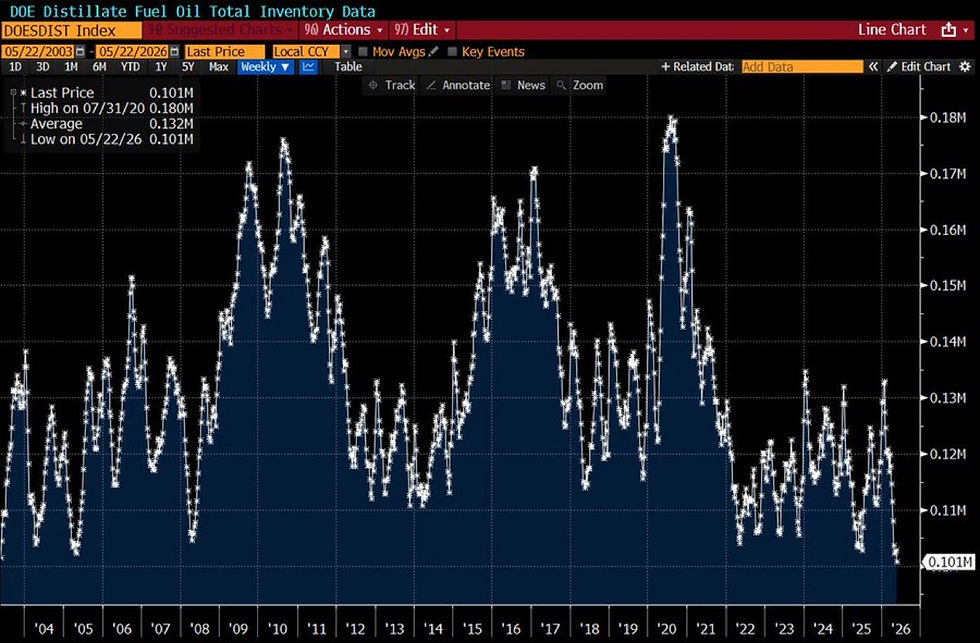
The market opened the week with a sharp divergence between paper and physical, but the underlying driver remains unchanged. Physical distillate markets continue to tighten while futures markets are liquidating on macro and positioning pressure. This is not a shift in fundamentals. It is a repricing of risk ahead of policy and geopolitical outcomes.
Singapore remains the clearest signal for the global system. 10ppm diesel is trading at $240.99/bbl with cash differentials at $51.4/bbl and refining margins near $68/bbl. Jet fuel is holding near $228/bbl with premiums in the low $30s. Backwardation continues to steepen and buying interest remains focused on prompt April barrels. This is a market that is still short supply.
Flows into Asia remain constrained. Saudi crude allocations to the region have been reduced again, Russian Baltic exports are disrupted and the Strait of Hormuz remains a live risk corridor. Iranian waivers are having limited impact on actual availability, with volumes still small relative to the deficit. Across the barrel, naphtha margins have surged to new highs with cracks above $429/mt and petrochemical run cuts beginning to appear, reinforcing that tightness is not isolated to diesel.
Against this backdrop, futures markets moved lower. WTI fell toward $91 and Brent toward $103, with heating oil and gasoil down sharply across the curve. This divergence reflects positioning and macro uncertainty rather than a loosening of physical balances. The MOVE index has turned higher, signaling rising volatility in rates and broader macro markets, which is feeding into liquidation across energy futures. Part of this reaction is linked to the role of the Strait of Hormuz not only as a physical chokepoint but also as a channel for petrodollar recycling. Disruptions or uncertainty around flows through the region impact the timing and stability of dollar circulation tied to Gulf exports, adding pressure to funding markets and amplifying volatility. As a result, futures are increasingly reacting to financial stress and liquidity concerns even as physical markets continue to price tightening supply.

Policy is now the second major driver. With the EPA expected to release updated RVO mandates before the end of the week, the market is positioning ahead of a binary outcome for biofuels demand. D4 RINs are holding near 1.58, reflecting this optionality. A stronger mandate would pull additional demand into the system and tighten feedstock balances, while a weaker outcome would reinforce the current oversupply narrative in vegetable oils.

Activity in the ARA biodiesel window remained steady with multiple prints across both FAME and UCOME despite broader weakness on the energy screen. FAME traded between 225 and 250 while UCOME cleared consistently in the 360 to 370 range. Using front month ICE gasoil at approximately $1284 per metric ton, this implies flat price levels of roughly $1510 to $1535 per metric ton for FAME and $1645 to $1655 per metric ton for UCOME. The structure is stable in absolute terms, but relative premiums continue to compress as gasoil trend is still higher.
Vegetable oil markets are moving in the opposite direction. Global sunflower production is projected at 54.1 million tonnes for 2025/26 versus 52.8 million tonnes last year, with strong gains in Argentina and steady output in Russia and the EU. While sunflower oil itself is not a primary biodiesel feedstock, the increase in supply is significant because it displaces other edible oils across food markets. This frees up soybean oil, rapeseed oil and other competing feedstocks to move into energy channels, effectively increasing available supply for biodiesel. At the same time, soybean oil export markets are weakening with deeply negative FOB Paranagua basis reflecting aggressive selling from Brazil and a long export tail from the record crop.

The result is a market split across three timelines. Physical energy markets are tight now and pricing scarcity. Vegetable oil markets are building structural surplus. Policy decisions on biofuel mandates are imminent and will determine how much of that surplus is absorbed into the energy system.
This is why current price action looks contradictory. Futures are reacting to macro and policy uncertainty, while physical markets continue to price shortage. That gap is unlikely to persist. Either physical premiums break or futures reprice higher. At current levels of diesel and jet pricing, the burden of adjustment remains on paper markets.


Comments