top of page
Search

Gasoil Rebounds but Diesel Complex Still Fragile as China Prepares Export Wave

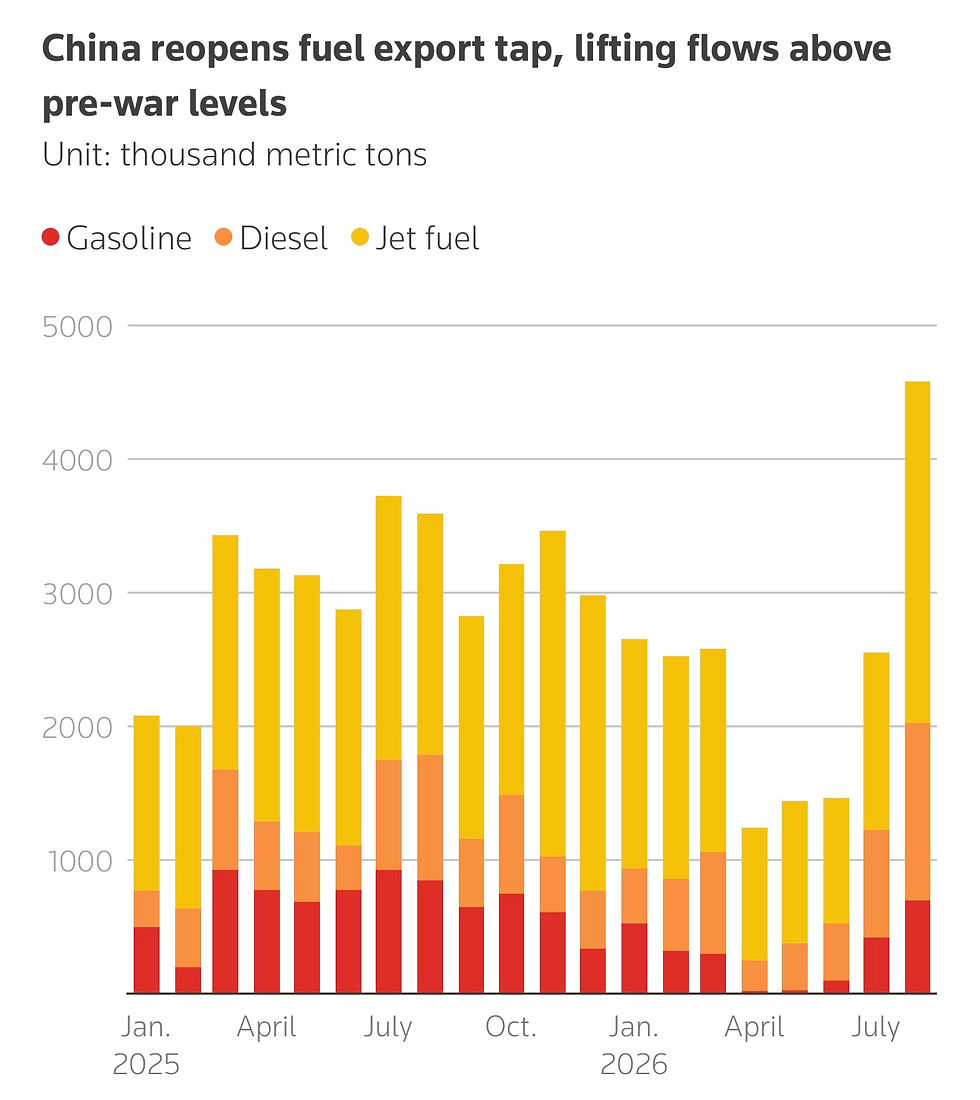
Today’s session delivered a stabilizing move rather than a genuine trend reversal. ICE Gasoil rebounded toward $742.75/mt, nearly a one-standard-deviation move higher from yesterday, but the structure did not follow: backwardation weakened again, confirming that the bounce was order-flow driven against a soft fundamental backdrop. The market is increasingly preparing for a large December wave of Chinese gasoil exports, a scenario we highlighted last week and that now looks inevitable. China’s domestic diesel demand is set to fall about 3% YoY in November, marking the sixth month of contraction, while refiners sit on record crude stocks and are staring at an extraordinary $46.50/bbl heat crack. That combination—weak demand, high margins, and ample crude—has historically triggered heavy product exports before year-end quotas reset.

ree

Vegetable oil markets were softer but more balanced. The Dec/Jul bean oil carry narrowed to –1.51, showing modest tightening even as global fundamentals remain heavy. Chinese port soybean stocks hit a fresh record of 10.33 million tons, with crushers easing throughput and U.S. replacement values rising during harvest—an unusual dislocation. Brazil, by contrast, remains priced to ship everywhere, highlighting how broken traditional trade flows have become. Daily U.S. sales improved, with 332,000 tons to China and another 355,000 tons to unknown destinations, but in the context of China’s swollen inventories these figures remain modest.


A correction is warranted regarding earlier expectations that BOPO might turn negative this year. With updated RFS modeling and the evolving structure of the U.S. soybean oil market, it is now clear that BOPO futures will not go negative. If Chicago bean oil futures rise on anticipated RVO adjustments restricting imported feedstocks, while palm oil futures soften under heavy global supply, BOPO futures will actually strengthen because CME bean oil reflects domestic delivery conditions for U.S. crushers. Since the 2026–27 RVOs are not yet published, this remains speculative—but the directional incentive for higher U.S. futures pricing is clear. However, physical BOPO at destination markets can still turn negative, and this is the more relevant dynamic for global flows. With global soybean oil basis under pressure from abundant South American supply and subdued Chinese demand, CIF SBO into India or Pakistan can become cheaper than delivered CPO, triggering substitution away from palm. In such a scenario, soybean oil displaces palm in key markets, pressuring international palm prices even as Indonesian mandates remain supportive.

ree

Palm oil therefore sits at the intersection of tightening domestic use in Indonesia and an increasingly heavy global soft-oil balance. While Indonesian blending programs continue to expand and governance initiatives may slow long-term acreage growth, these bullish structural factors may not be strong enough to lift futures if soybean oil remains oversupplied worldwide. China’s swollen bean stocks, Brazil’s aggressive pricing posture, Argentina’s return to higher crush levels, and the prospect of firmer U.S. soybean oil futures under a revised RVO regime all create headwinds for palm. The more probable scenario is that palm oil futures remain capped, with any strength meeting exporter selling and the threat of further displacement in India if SBO basis continues to weaken relative to CPO.


European biodiesel indicators were steady but still reflect a structurally weak market. RME traded at €732.83 (flat price around $1,478/mt) and UCOME at $1,534/mt, keeping UCOME well above FAME. HVO Class 2 traded around $2,533/mt, maintaining a $1,000+ premium over UCOME, but this widening spread should not be misinterpreted. The high HVO flat price does not reflect strong FAME/UCO demand in Europe, nor does it reroute UCO away from Asia. Instead, it underscores how weak European diesel fundamentals and refinery economics have become: cracks are depressed, run rates are low, and discretionary blending minimal. Asia continues to dominate UCO procurement because SAF and HVO margins at origin remain structurally stronger. Europe may show high HVO flat prices, but its underlying pull for feedstocks is weak.


In the U.S., biofuel policy remains the core driver. Farmdoc’s revised RFS projections show that under “no-imports” or “status-quo” half-RIN scenarios, renewable diesel production rises to 4.4–4.8 billion gallons in 2027—equivalent to 12.65–13.80 million metric tons at 0.76 kg/L—while FAME output climbs toward 2.3–2.5 billion gallons, or 7.49–8.14 million metric tons at 0.86 kg/L. Combined, this pushes domestic feedstock demand up by nearly 20 billion pounds annually, equivalent to roughly 9.1 million metric tons, or close to a quarter of the total U.S. fats and oils supply base. But it is equally important to acknowledge the political ceiling on RIN prices: high D4 or D5 RINs are not politically acceptable, and any sharp rally or spike will almost certainly trigger a policy response—whether through revised volume obligations, enhanced flexibility mechanisms, or accelerated rulemaking designed to cap RIN costs for refiners and consumers. Meanwhile, new bipartisan legislation enabling maritime fuels to generate RFS credits could unlock another multi-billion-gallon demand channel—potentially rivaling the entire current U.S. biodiesel market. With Brazil adding supply and China buying inconsistently, U.S. policy becomes the primary anchor supporting soybean oil even as futures remain volatile.

ree

Adding to the broader supply picture, today’s USDA balance sheets reinforced abundance across grains. Corn stocks remain heavy with only minor yield adjustments; soybean stocks eased slightly but not enough to alter the bearish tone; and wheat saw a substantial increase in global production and ending stocks. This abundance of grain does little to support vegoil in the near term but reinforces the medium-term case for rising energy-sector absorption through biodiesel, HVO, SAF, and possibly maritime fuels should legislation clear.


Taken together, today’s stabilization masks a larger structural transition. Gasoil’s rebound is overshadowed by the looming Chinese diesel export wave. Palm faces meaningful resistance from an oversupplied global soybean oil complex. Soy oil futures in Chicago may disconnect upward if RVOs limit imports, while global soft-oil basis remains unusually weak. Europe remains uncompetitive in feedstock procurement, while Asia absorbs most of the UCO-driven HVO/SAF flow. As year-end approaches, the market braces for volatility across diesel, vegoils, and renewable fuel credits as trade flows reshuffle around cracks, mandates, and China’s next move.

ree


Comments


©2022 by globalbiodiesel. Proudly created with Wix.com

bottom of page