Frustrated Fuel Oil Spikes While Vegoils Flush: Markets Navigate Dry Rivers and Record Harvests

Crude oil markets remain volatile with Brent trading near $115 per barrel and WTI around $102.89. Persian Gulf crude oil loadings surged back above 10 million barrels per day over a 7-day trend, largely driven by Saudi Arabia loading 9 VLCCs in a single day, breaking a four-day slump. Within the broader distillate complex, the heating oil crack margin has dropped back to 99.43. Despite this cooling in the Heat crack, the "frustrated" fuel oil market is spiking wildly, with the 0.5% East-West spread hitting $165.25 per metric ton. Traders are weighing these supply dynamics against geopolitical risks, as the window for a potential "short, intense" military campaign in the Middle East remains open regardless of the upcoming US election results. Interestingly, these easing wholesale diesel margins aren't providing immediate relief to consumers; retail diesel prices remain stubbornly high, with some fuel stations resorting to taped-on paper numbers to update soaring prices, as seen with diesel hitting $6.59/gal.

Inland river logistics remain a major bullish factor for freight and localized basis. European logistics face severe constraints, with the Rhine River at Kaub peaking at just 58 cm before a projected steep drop to the mid-20s by early November. This is keeping spot barge freight to Basel elevated at €254.50 per tonne. In the physical biofuels market, spot pricing remained active with window deals showing FAME 0 averaging $1,594.71 and UCOME averaging $1,704.77, however, Northwest Europe (NWE) paper trading remains very slow and sluggish. The Ukrainian harvest is effectively wrapping up, with soybeans nearing 3.2 million tonnes and sunflower seeds plateauing around 9.8 million tonnes.

The US soybean harvest progress sits at a strong 79%, running 2 percentage points ahead of the 5-year average. This smooth completion contrasts sharply with South America, where excessive moisture has stalled planting progress in Brazil's Parana state, with some cities receiving over 300 mm of rain this month and farmers warning of extended bean cycles and elevated disease risks. In North America, regulatory shifts took the spotlight today as Canada proposed changes to its Clean Fuel Regulations (CFR) to improve the competitiveness of domestic low-carbon fuels relative to imports. Rather than a domestic content mandate, the amendments introduce a credit multiplier for "related compliance credits" generated from feedstocks sourced in Canada, the US, or Mexico. The proposal assigns a 0.5 factor to Hydrogenation-derived renewable diesel, 0.8 to SAF, and 0.4 to Biodiesel. Feedstock markets remained relatively quiet, with the US Gulf UCO benchmark holding steady at 71.0 cents per pound, or approximately $1,565 per tonne.
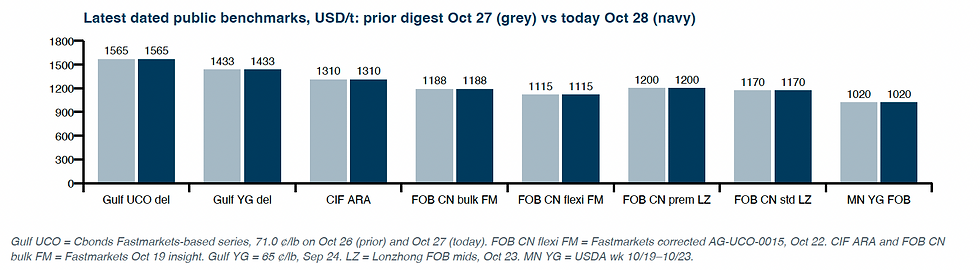
Despite Brazilian weather concerns, heavy losses in Chinese vegetable oil futures and mounting palm inventories triggered a sell-off in Crude Palm Oil (CPO), pushing the active January contract down to 4,702 ringgit per tonne. Crucially, the POGO (Palm Oil over Gasoil) spread is deeply negative, pricing at -$254.30 for November and -$182.00 for December. No one should underestimate the effect of this negative $200 spread through December; it is a significant market incentive that blenders and traders can actively plan around. Asian demand remains a bright spot in the feedstock sector, with Indian refiners HPCL and BPCL seeking roughly 83,000 tonnes of UCO ahead of India's upcoming 1% SAF mandate on international flights.

CME soybean oil futures followed the Asian weakness, falling to 65.56 cents per pound. Given that we have now traded below the Chicago soyoil support level of 66 cents/lb, and the Dec/May carry spread has collapsed down to -1.00, the flush in veg oils is expected to continue. The large oilseed harvest in Ukraine and Russia will also likely weigh heavily on markets heading into spring 2027. On the logistics front, the Mississippi River situation is worsening, with the St. Louis gauge plunging to 3.82 ft and forecast to drop below 3 ft by Sunday. Downstream, Memphis logged its fourth day below the 0.0 ft low-water trigger, keeping USDA barge rates for the Cairo-Memphis segment in "ALERT" status at 24.5% below the 90-day moving average. These severe inland freight constraints are adding significant additional pressure to already very high vessel transportation costs at sea for any imports or exports, suggesting total freight costs will remain punitive for the near term - as it pushes origin prices lower.


Comments